Baked Chicken Wings That Crackle: The Baking Powder Method
Crisp baked chicken wings from a home oven: the baking powder trick, a rack over a sheet pan, 400 or 425°F, and fixes for soggy or sticking wings.
By Megan Tremblay10 min read
Baked chicken wings have a bad reputation, and most of the time they've earned it. They come out pale and soft, sitting in a slick of their own fat, and no amount of sauce hides that. Done right, with a light coat of baking powder, a wire rack and a properly hot oven, an ordinary home oven turns out wings with thin, blistered skin that crackles when you bite down. I spent years on a pub fryer station, and at home I still bake wings more often than I fry them: two pounds fit on one pan, nothing spits at me, and cleanup is a sheet of foil.
The short version: toss very dry wings with salt and baking powder, spread them on a rack set over a sheet pan, and bake at 425°F (220°C) for 35 to 45 minutes, turning once, until the thickest piece reads 175 to 190°F (79 to 88°C).
At a glance
| What | Details |
|---|---|
| Yield | 2 lb (900 g) party wings, about 18 to 20 pieces |
| Serves | 2 when wings are the meal, 4 as one snack among several |
| Oven | 425°F (220°C), or 400°F (205°C) if your oven runs hot |
| Bake time | 35 to 45 minutes at 425°F; 40 to 50 minutes at 400°F |
| Turning | Once, halfway through |
| Prep | 10 minutes, plus an optional 1 to 24 hours uncovered in the fridge |
| Done | 175 to 190°F (79 to 88°C) in the thickest drumette; 165°F (74°C) is the safe minimum |
Ingredients for 2 lb (900 g) of wings
- 2 lb (900 g) chicken wings, split into drumettes and flats, tips removed
- 2 teaspoons aluminum-free baking powder (not baking soda)
- 2 teaspoons kosher salt, or 1 teaspoon fine table salt
- 1/2 teaspoon freshly ground black pepper
- 1/2 teaspoon garlic powder (optional)
- A little neutral oil for the rack
- 1/2 cup (125 ml) sauce for tossing, or one of the finishes further down
You'll also need a rimmed half sheet pan, roughly 18 by 13 inches (46 by 33 cm), an oven-safe wire rack that sits inside it, foil, tongs, a big mixing bowl and an instant-read thermometer.
One half sheet pan holds about 2 pounds in a single layer. For a bigger group, the wings calculator works out how many pounds to buy and how much sauce to make for your headcount.
How to make oven baked chicken wings
- Heat the oven to 425°F (220°C) with a rack in the upper-middle position. Line the sheet pan with foil, set the wire rack on top and wipe the rack with a paper towel dipped in oil.
- If your wings came whole, split them. Cut through the two joints (the knife drops into the gap when you find it) and freeze the tips for stock. Pat every piece dry on both sides with paper towel. Press, don't dab.
- Whisk the baking powder, salt, pepper and garlic powder together in a small bowl. Mixing first spreads the baking powder evenly, so no wing ends up with a chalky patch.
- Put the wings in the big bowl, sprinkle over a third of the mix and toss. Repeat twice. You want a fine, even dusting that mostly vanishes into the skin. If white powder is still sitting on a piece, brush some off.
- Lay the wings on the rack skin side up, a finger's width apart. Flats sit flat; drumettes can rest on their sides.
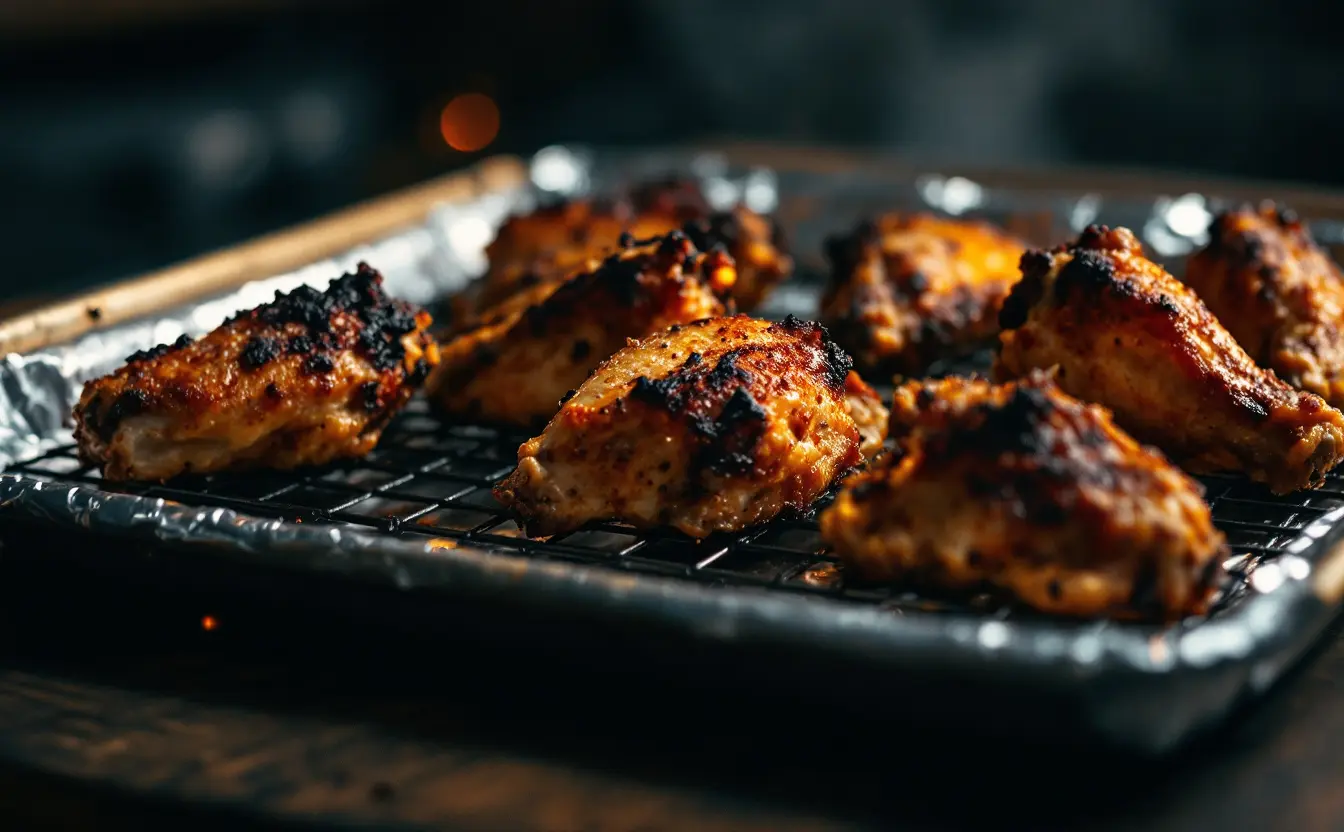
- Bake for 20 minutes. Turn each piece with tongs, rotate the pan front to back, and bake another 15 to 25 minutes, until the skin is deep golden, tight and covered in small blisters.
- Check the thickest drumette with the thermometer, keeping the tip off the bone. You want 175 to 190°F (79 to 88°C). Flats usually get there a few minutes before drumettes, so pull pieces as they finish.
- Leave the wings on the rack for 3 to 5 minutes. The skin firms up as the last of the steam escapes. Then sauce and serve.
The best upgrade costs nothing but time. After step 4, put the seasoned wings on their rack in the fridge, uncovered, for anywhere from an hour to a full day. The skin dries out, turns slightly translucent and bakes up noticeably crisper.
Why baking powder makes crispy baked wings
Crispy baked wings come down to two problems: water on the skin and fat underneath it. The oven has to drive off the first and melt the second before the skin can brown, and dry oven air does both slowly. Baking powder speeds things along. It makes the surface of the skin less acidic, which helps it brown sooner, and the tiny bubbles it forms leave a pebbled texture that crisps far more like a fried wing than a roasted one. The comparison of fried, baked and smoked wings goes further into the chemistry. These are the practical points:
- Buy aluminum-free. Some baking powders contain sodium aluminum sulfate, and on something as exposed as wing skin it can leave a faint metallic taste. The ingredient list tells you which kind you have.
- Never swap in baking soda. It's much stronger, and at any amount that would coat two pounds of wings it tastes soapy.
- Check that it's fresh. Stir 1/2 teaspoon into a few spoonfuls of hot water. If it doesn't fizz hard straight away, the tin has had its day.
- Stick to about 1 teaspoon per pound. More powder doesn't buy more crunch, only a bitter edge.
The rack over the sheet pan does half the work
Put wings straight on a pan and the undersides sit in rendered fat and juice. That side half fries and half steams, and it comes out pale, greasy and soft while the top looks fine. A rack lifts every piece about half an inch (1 cm or so) so hot air reaches all sides and the fat drips onto the foil, where it can't touch the skin again.
Use a plain steel or stainless cooling rack that's sold as oven safe. Some non-stick coated racks aren't meant for high heat, so check before yours goes in at 425°F. Without a rack, put parchment directly on the pan, flip the wings twice instead of once, and carefully pour off the fat at the halfway point. They'll be decent. They won't crackle.
400°F or 425°F: how long to bake chicken wings
These ranges match the chicken wing cooking times tool, which also covers the air fryer, deep fryer, smoker and grill.
| Oven temperature | Thawed wings | From frozen | When to turn |
|---|---|---|---|
| 400°F (205°C) | 40-50 minutes | 50-65 minutes | Halfway |
| 425°F (220°C) | 35-45 minutes | 45-60 minutes | Halfway |
| 450°F (230°C) | 30-40 minutes | 40-55 minutes | After 20 minutes |
425°F (220°C) is my default. It renders the fat quickly, and the skin blisters before the meat has a chance to dry out.
At 400°F (205°C), chicken wings take 40 to 50 minutes when thawed, turned once at the halfway mark. That's the better choice when your oven runs hot, when you're using a dark pan that browns the bottoms fast, or when the wings are jumbo and the meat needs extra minutes to catch up with the skin. The skin ends up a touch less blistered but very even.
450°F (230°C) is fastest, but the drippings on the foil can start to smoke, and flats can scorch at the edges before the drumettes are done.
Two adjustments catch people out. Convection fans brown faster, so either drop the temperature by 25°F (about 15°C) or start checking 10 minutes early. Two pans at once means swapping them between racks at the turn and adding 5 to 10 minutes.
Saucing baked wings
Sauce goes on last, right before the wings go to the table. Warm the mixing bowl with hot water and dry it so butter-based sauces don't seize on cold metal, add the wings, pour the sauce down the side of the bowl and toss with a few flips of the wrist. Half a cup (125 ml) is right for two pounds. Baking powder skin holds up under sauce longer than plain baked skin, but the clock still starts the moment they meet.
Classic Buffalo is the obvious choice, and the butter to hot sauce ratios are in the comparison piece linked above. The wing section of the game-day food guide has more ideas. These two suit oven wings especially well.
Honey garlic glaze
Simmer 3 tablespoons honey, 2 tablespoons soy sauce, 1 tablespoon butter, 2 grated garlic cloves and 1 teaspoon rice vinegar for 2 to 3 minutes, until it coats a spoon. Toss the wings, put them back on the rack and return them to the 425°F (220°C) oven for 3 to 4 minutes so the glaze sets tacky instead of running off. Stay by the oven. Honey goes from glossy to burnt in about a minute.
Chili crisp and lime
Stir 4 tablespoons chili crisp with 1 tablespoon honey, the juice of half a lime and a pinch of salt. The oil clings to blistered skin and the crunchy bits catch in every crevice. Finish with sliced green onion. No second bake needed.
Make-ahead baked wings for game day
Baked wings are friendly to a schedule.
- Season ahead. Coat the wings and leave them uncovered on the rack in the fridge for up to 24 hours. It's the same dry rest from the method.
- Bake ahead. Bake them fully, cool them on the rack, then refrigerate them covered for up to 3 days. Reheat on the rack at 400°F (205°C) for 10 to 15 minutes, until the skin crackles again and the centre is at least 165°F (74°C). Sauce after reheating.
- Don't half bake. Partly cooking chicken and finishing it later is a food safety problem: the meat spends time warm enough for bacteria to grow without getting hot enough to kill them. Cook it all the way or not at all.
- Hold for the party. Keep finished, unsauced wings on the rack in a 200°F (93°C) oven, uncovered, and sauce small batches as they go out.
Troubleshooting soggy, sticking and uneven wings
Soggy or soft skin
Nearly always water or crowding. Wings that went in damp, pieces touching each other, a pan with no rack, or an oven cooler than its dial will all give you soft skin. Covering wings while they wait, or saucing them too early, undoes good skin after the fact. To rescue a soft batch, put it back on the rack at 425°F (220°C) for 5 to 8 minutes before saucing.
Wings sticking to the rack
Raw skin bonds to bare metal as its proteins set, which is why the oiled rack matters. Don't try to turn the wings before the 20 minute mark. By then the skin has firmed, and most pieces lift cleanly with a twist of the tongs rather than a pull. Afterwards, soak the rack in hot, soapy water for half an hour and the stuck bits brush right off.
Uneven browning
Every oven has a hot corner, usually at the back, and rotating the pan at the turn evens most of it out. Mixed sizes are the other cause. Big drumettes and small flats won't finish together, so put the drumettes around the edges of the pan, where the heat is stronger, and the flats in the middle, or simply pull the flats early.
FAQ
How long do chicken wings take in the oven?
At 425°F (220°C), thawed chicken wings take 35 to 45 minutes on a rack, turned once halfway. At 400°F (205°C) allow 40 to 50 minutes, and at 450°F (230°C) about 30 to 40. Finish by temperature rather than the clock: 175 to 190°F (79 to 88°C) in the thickest piece.
Can you bake chicken wings from frozen?
Yes, though thawed wings crisp better. Add 10 to 15 minutes to the times above. Seasoning slides off icy skin, so bake the frozen wings plain for the first 10 to 15 minutes, pat them dry, toss them with the salt and baking powder, then return them to the rack and carry on.
Should chicken wings be covered in the oven?
No. A cover traps steam, and steam is the reason baked wings go soft. Bake them uncovered on a rack and keep them uncovered while they wait.
Can I use cornstarch instead of baking powder?
Cornstarch gives a crisp, dry coating, but it doesn't change the skin's chemistry or blister it the way baking powder does, and too much leaves a dusty finish. If it's all you have, use about 1 teaspoon per pound and shake off the excess. For skin that crackles under a fork, baking powder is the one to keep in the cupboard.