Best Meat Thermometer for Grilling and Smoking: Instant-Read and Leave-In Picks
How to choose a meat thermometer for the grill or smoker, where to put the probe, how to check it in ice water, and the temperatures that make food safe.
By Colin MacAulay12 min read
Every health inspection I sat through in a restaurant started the same way. The inspector walked past the host stand straight to the line, and the first thing out of the bag was a meat thermometer with a long steel probe. It went into the soup on the steam table, the chicken in the reach-in and the burger just off the flat-top, and every number went into the report. The cooks who never sweated those visits already carried a probe in their sleeve pocket and used it on every ticket.
At home there is no inspector, which is exactly why the thermometer matters: it is the one grilling tool that turns a guess into a fact. This guide is for anyone who cooks over fire, from weeknight burgers to a pork shoulder that rides the smoker through a Sunday of football. The short answer: buy a fast instant-read thermometer first, because it handles almost everything you cook. If you smoke big cuts, add a leave-in probe with an alarm so the lid can stay shut. Below are four picks, then where to probe, the temperatures that matter and how to check your thermometer.
How to choose a meat thermometer
- Start with an instant-read. You hold it in the food for a moment, read it and take it out. It covers almost everything, plus the final check on anything big.
- Pay attention to speed. A probe that settles in a second or two means less time with your hand over the coals and the lid open. Slow probes tempt you to pull out before the number finishes climbing, and that early reading is always low.
- Get a probe with reach. A thin, longish probe gets to the centre of a thick chop without your knuckles meeting the grate.
- Make sure you can read it in bad light. By November the sun is down before dinner, and a display you squint at is a display you stop checking.
- Know how it calibrates. Some arrive calibrated, some can be adjusted at home, and all of them can be tested in ice water.
- Add a leave-in probe only if you cook long. Wired probes with an alarm suit a smoker a few steps from the back door. Wireless ones drop the cable and let you wander farther.
Best overall: ThermoWorks Thermapen ONE
This is the instant-read a lot of serious home cooks end up with, built by a company that makes thermometers and nothing else. The maker quotes a reading in about one second, and the probe folds into the body, so it rides in an apron pocket or a drawer without stabbing anybody.
Speed sounds like a luxury until you are standing over a full grate of wings with heat rolling out past your face. A one-second reading means you can check six drumettes in the time a slow probe checks two, including the thick one hiding in the back corner. It suits anyone who grills often or cooks for a crowd on game day.
The trade-off is cost. It sits at the top of the instant-read range, and a budget probe does the same job a second or two slower. If you grill a handful of times a summer, that gap may never bother you. If you cook every weekend until the snow is on the lid, you will feel it every cook.
Budget pick: Alpha Grillers Instant-Read Thermometer
A pocket-sized instant-read probe that does the essential job. The maker says it reads in 1 to 2 seconds and comes calibrated out of the box, which is all most people need for burgers, chicken breasts and the last check on a roast.
It suits first-time grill owners, balcony cooks and anyone who has been cutting into chicken to check the colour and wants to stop. It also makes a sensible second thermometer for the kitchen drawer.
Factory calibration is a starting point, not a lifetime guarantee, so run the ice water check below every so often, and always after a drop onto the patio. Like any instant-read, it is made for quick checks, not for riding along inside a closed grill.
The upgrade for long cooks: TempPro TempSpike
A pork shoulder can spend most of a day on the smoker, and every lid lift lets heat escape and stretches the clock. This is a leave-in wireless probe built for those long smokes. It goes into the meat at the start, the lid closes, and you follow the temperature without walking out to the deck every half hour. The maker quotes a range of up to 500 ft, and the probe is waterproof, which makes cleanup simpler.
It suits people who smoke big cuts and would rather watch the game than the smoker.
The trade-offs come with the category. Wireless probes need to go deep into the meat, at least as far as the maker specifies, which makes a wing or a thin chop the wrong job for them. And any leave-in reads one spot, so before a big cut comes off, confirm with an instant-read in two or three places.
Also good: ThermoWorks DOT
The DOT is a wired leave-in probe with one job: it sounds an alarm when the meat reaches the number you set, and setup is meant to be one touch. The probe goes in, the cable runs out under the lid, and the unit waits on the side shelf.
A wired alarm thermometer is a plain, dependable choice for a smoker or kettle a few steps from the back door. Route the cable where the lid will not pinch it and keep it out of direct flame. And an alarm only helps if you can hear it over the game, so check the probe at commercial breaks anyway.
Instant read thermometer or leave-in probe?
| Type | How you use it | Best for | Watch for |
|---|---|---|---|
| Instant-read (folding or pen) | Quick checks with the lid open | Burgers, steaks, chops, chicken, wings, final checks | Not made to stay in a closed grill |
| Wired leave-in with alarm | Probe stays in, cable runs to a unit outside | Pork shoulder, roasts, turkey on the smoker | Pinched or scorched cables |
| Wireless leave-in | Probe stays in, no cable | Long smokes, big yards | Real-world range, minimum depth |
| Dial, oven-safe | Stays in a roast | Big roasts when nothing else is around | Slow, thick stem, hard to read |
| Lid or dome gauge | Built into the grill | A rough idea of the air temperature | Says nothing about the food |
| Pop-up timer | Comes in some turkeys | Nothing you should rely on | Check with a real thermometer anyway |
An instant-read alone handles most home grilling. Wings in particular finish unevenly, so you want to poke several pieces rather than trust one probe in one drumette; the smoked chicken wings method shows how that plays out on the smoker. A leave-in earns its place when the cook runs for hours. Plenty of people who smoke own one of each: the leave-in tells you when to start paying attention, and the instant-read tells you when it is done.
Wireless meat thermometer: what the range figure means
Every wireless range number is a best case. Metal smoker lids, exterior walls, appliances and a room full of people between you and the grill all shorten it, so treat the figure as a ceiling. Test it before it matters: on an ordinary weeknight, set the probe up on the grill and walk to the spot where you will watch the game. If the signal holds, you are fine. If it drops, move your seat or plan on a walk outside at halftime. Charge or check batteries the night before a long cook, not at 6 a.m. with the fire lit.
Probes with no cable at all are the other route. MEATER built its range around them: the probe goes into the meat with only its blunt end showing, reads the meat and the air around it, and talks to your phone, so no cable has to pass under the lid. The same range caveats apply, and the probe has to go in past the line the maker marks on it.
Where to probe, cut by cut
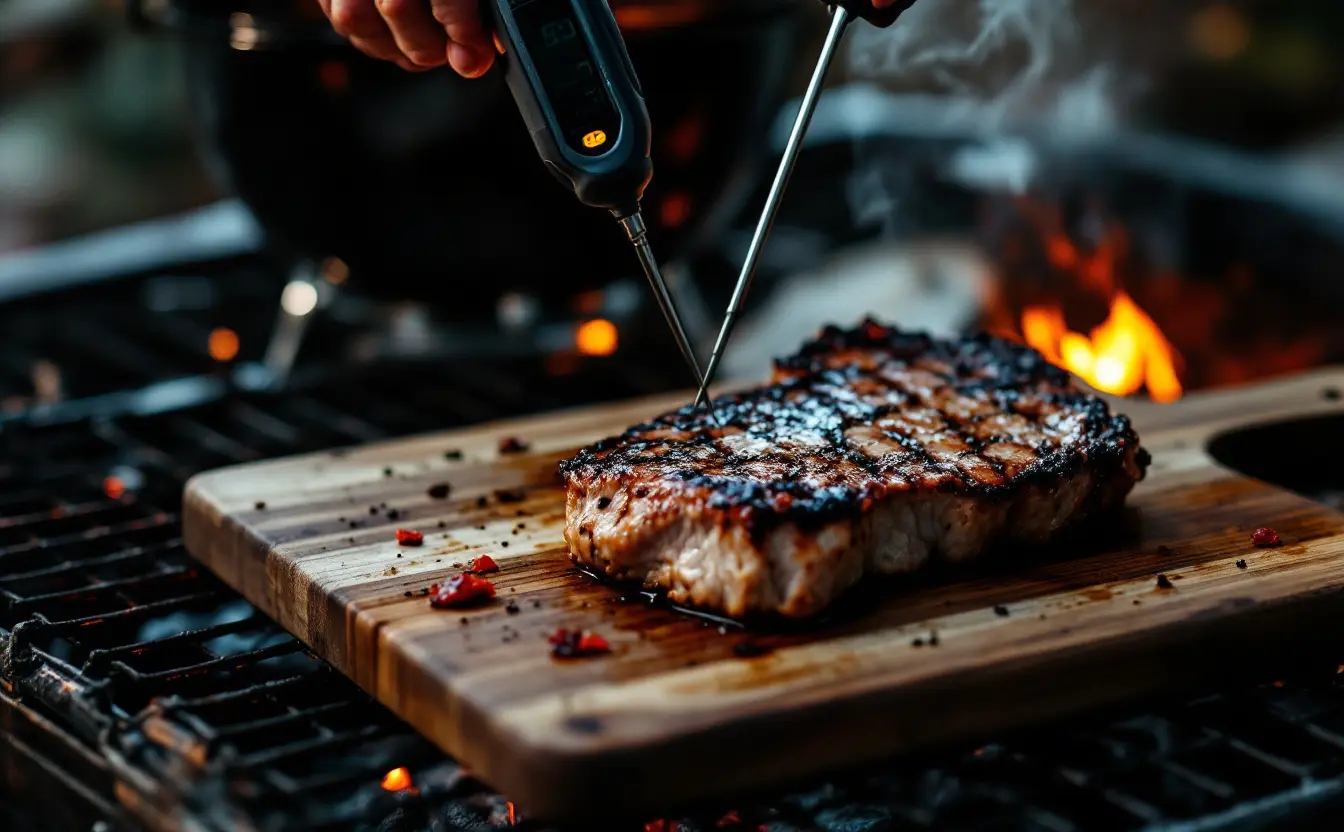
The reading that counts is the coldest point, usually the centre of the thickest part, with the tip clear of bone, fat and gristle. With an instant-read, push past where you think the centre is, then draw the probe back slowly. The lowest number you see on the way out is your reading.
- Burgers: go in from the side, into the middle of the patty, not down from the top. From the top, the tip punches through to the hot grate side and reads high.
- Steaks and chops: from the side, into the centre of the thickest part. On a bone-in chop, stay a finger's width away from the bone.
- Chicken breasts: from the thick end, horizontally, into the centre.
- Wings: the thickest drumette, alongside the bone without touching it. Check several, from different parts of the grate.
- Whole chicken or turkey: the thickest part of the breast, the innermost part of the thigh and the innermost part of the wing, all without touching bone. Go by the lowest of the three.
- Pork shoulder and brisket: the centre of the thickest part. When the probe slides in with almost no resistance, the meat is close.
- Sausages: from the end, lengthwise, into the middle.
- Fish fillets: from the side, into the thickest part.
Safe temperatures, in plain terms
The USDA's safe minimums are easy to remember once you sort food into three groups:
- 145°F (63°C) for whole cuts of beef, pork, veal and lamb, such as steaks, chops and roasts, followed by a three-minute rest. Fish uses the same number.
- 160°F (71°C) for ground meats such as burgers and most sausage.
- 165°F (74°C) for all poultry, whole or in pieces, including ground chicken and turkey, and for reheated leftovers.
Health Canada publishes its own chart, and for a few foods, pork and whole birds among them, it sets a higher number. Canadian cooks should look it up once and tape it inside a cupboard door.
Safe is the floor, not the target. Wings are safe at 165°F (74°C) but much better at 175 to 190°F (79 to 88°C), where the connective tissue softens. Pork shoulder and brisket are safe hours before they are good, and most cooks take them to around 195 to 205°F (90 to 96°C). Thick cuts also climb a few degrees after they leave the heat, so pull a thick steak or roast slightly short.
For quick cooks, the grill time calculator gives the minutes per side, the temperature to pull at and the safe minimum for each food. For long ones, the smoking time calculator works back from dinner to when the fire should be lit, and the probe tells you whether you are ahead or behind.
How to calibrate a meat thermometer in ice water
A properly made glass of ice water sits at the freezing point wherever you live, which makes it the best reference you own.
- Fill a tall glass to the top with ice. Small cubes or crushed ice work best.
- Add cold water until it is just below the top of the ice, then stir and let it sit for about three minutes.
- Put the probe into the middle of the glass, at least 2 in (5 cm) deep, without touching the sides or bottom.
- Stir gently and wait for the number to settle. It should read 32°F (0°C).
- If it is off, adjust it the way the maker describes, such as a reset function or the small nut under the head of a dial thermometer. If it cannot be adjusted, note the offset on a piece of tape, or replace it if it is off by more than a couple of degrees.
Boiling water is a second check, but only at sea level does it sit at 212°F (100°C). Higher up it boils cooler, which is why ice water is the better test.
Check a thermometer when it is new, after any drop and before a big cook. With US Thanksgiving later in the month (Canadians had theirs in October), early November is a good time to fill a glass with ice, rather than finding out on turkey day that the probe reads five degrees low.
Habits that keep the numbers honest
Every kitchen I worked with kept a temperature log on a clipboard by the walk-in. The habits behind it translate straight to a backyard.
- Clean the probe between raw and cooked food with hot soapy water or a food-safe sanitizing wipe.
- Check more than one piece. Every grill has hot and cool spots, and the pieces near the edge will lag.
- Do not trust the dome. The lid gauge reads the air near the top of the grill, not the food, as the charcoal grilling guide for beginners explains.
- Give it a home. A thermometer that hangs on a hook by the grill gets used. One in the junk drawer does not.
How we chose
We have not used these thermometers ourselves for this guide. The picks come from the makers' published details (reading speed, probe style, factory calibration, wireless range, alarm setup), the strengths and complaints owners commonly report for each type, and years of watching cooks and inspectors work with probe thermometers in busy kitchens. We split the picks by job, because no single thermometer does quick checks and long cooks equally well. Where a figure comes only from the maker, such as wireless range, we say so.
FAQ
Do I need a meat thermometer if my grill has one in the lid?
Yes. The lid gauge reads the air near the top of the dome, which can be well off the temperature at the grate, and tells you nothing about the inside of the food. Use it for the fire and a meat thermometer for the meat.
How long do you leave an instant-read thermometer in the meat?
Until the number stops moving, which for a fast probe is a second or two and for a slow one can be several. Pull it out early and it reads low. Once it settles, take it out; instant-reads are for checks, not for staying in under a closed lid.
Is a wireless meat thermometer worth it?
If you smoke big cuts for hours, it saves trips outside and keeps the lid shut, which keeps the heat steady. For burgers, steaks and wings, an instant-read is quicker and simpler.
Where do you put the thermometer in a turkey?
In the thickest part of the breast and the innermost part of the thigh and wing, without touching bone. The bird is done when the lowest of those readings reaches 165°F (74°C) by the USDA's number; Canadian cooks should also check Health Canada's figure for whole poultry, which is higher.