Charcoal Grilling for Beginners: Tips and Tricks for Game Day
A first-timer's guide to charcoal: lump or briquettes, a chimney start, a two-zone fire and a cooking plan that has everything off the grill by tip-off.
By Megan Tremblay9 min read
I spent years cooking on a gas flat-top, where the heat comes from a knob and never changes its mind. Charcoal was a different animal. The first time I grilled burgers on a kettle for a playoff game, I spread the coals edge to edge, put the patties on while the fire was still flaming, and spent the first quarter chasing flare-ups with a spray bottle. The burgers came out black outside and grey inside. Nobody said anything, which was worse.
Charcoal isn't hard. It has a handful of rules nobody bothers to tell you, and once you know them, a kettle is one of the most forgiving ways to cook for a crowd.
The kit
A basic kettle grill with a lid and adjustable vents covers everything here. Add a chimney starter, newspaper or paraffin starter cubes, long tongs, a sturdy spatula, heat-resistant gloves, an instant-read thermometer, a grill scraper and a metal can with a tight lid for ash. Leave the lighter fluid on the store shelf.
Lump charcoal or briquettes
Both work. They just behave differently.
Lump charcoal is wood that has been heated in a low-oxygen kiln until mostly carbon is left. It lights quickly, burns hot and leaves little ash. The pieces are irregular, so the heat is less even and the fire burns down sooner.
Briquettes are pressed from charcoal fines with a binder, usually starch. They're uniform, so they light evenly and burn steadily, which makes the heat far easier to predict. They take a little longer to light and leave more ash. Avoid the self-lighting kind pre-soaked in fluid.
For a first season, start with plain briquettes, because predictable heat is what you want while you learn the vents and the lid. Add a bag of lump for hot, fast searing once you're comfortable.
Light it with a chimney
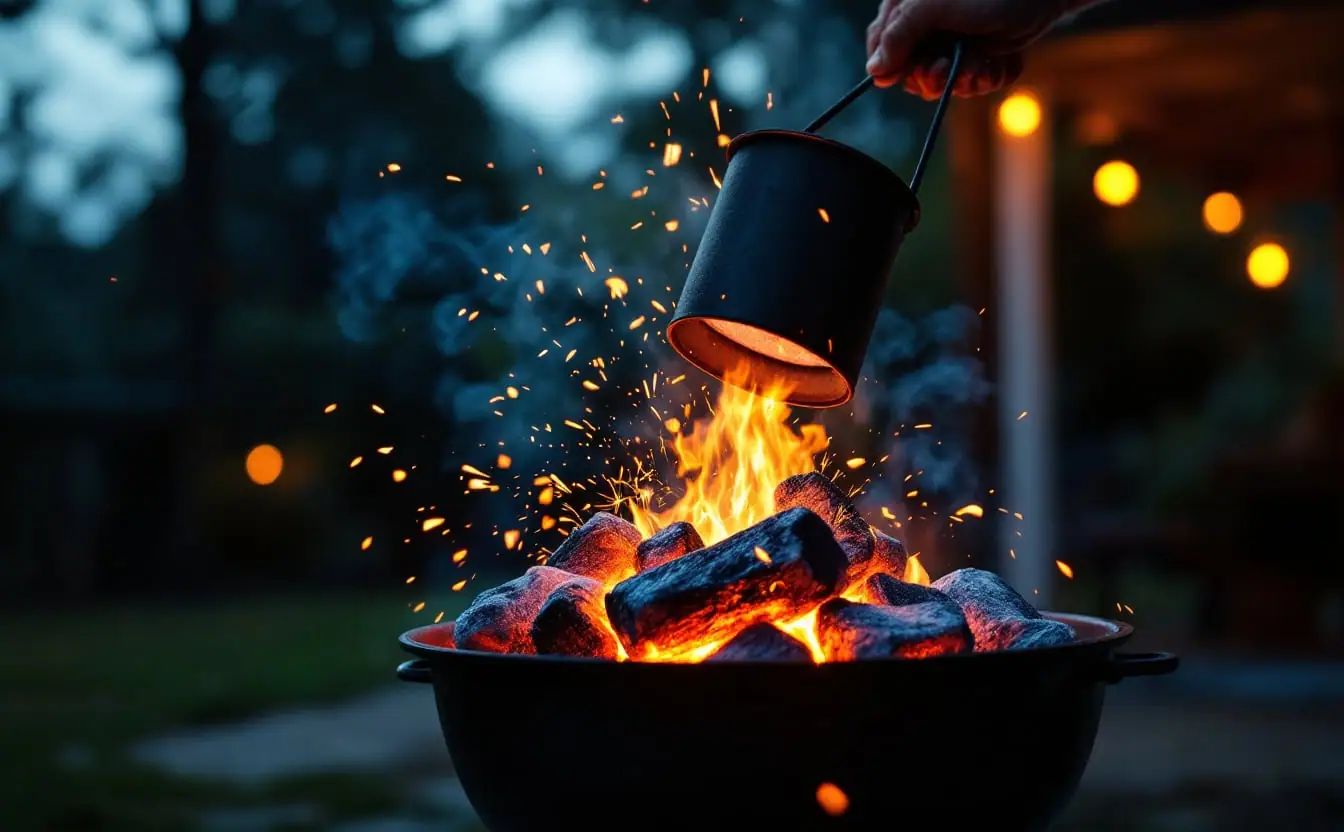
A chimney starter is a metal cylinder with a grate near the bottom. Fire underneath draws air up through the coals, and the whole load catches with nothing but newspaper.
- Lift out the cooking grate. Put two sheets of loosely crumpled newspaper, or two paraffin cubes, on the charcoal grate.
- Set the chimney over them and fill it with charcoal. A full chimney suits most game-day cooks on a standard 22-inch (57 cm) kettle.
- Light the paper through the holes near the base.
- Wait until the top coals are covered in light grey ash and flames lick up through the top: 15 to 20 minutes for briquettes, 10 to 15 for lump.
- With gloves on, pour the coals where you want them. Set the hot chimney down on concrete, never on grass or a wooden deck.
Lighter fluid tastes faintly of petroleum if food goes on before it burns off, and it's the easiest way to get a plume of flame toward your face. Never squirt it onto lit coals.
Build a two-zone fire
If you take one idea from this page, make it this one. Pour all the lit coals onto one side of the kettle and leave the other side empty. Now you have two cooking areas:
- The direct side, over the coals, for searing, charring and browning.
- The indirect side, with nothing beneath it, for gentle cooking with the lid down and for rescuing anything that's flaring up or browning too fast.
Most beginner disasters start with coals spread evenly from edge to edge, which leaves nowhere to go when things get away from you. With two zones you can slide a burger off a flare-up, cook thick sausages through without splitting them, and park finished food where it stays warm.
Before any food goes on, put the grate back, close the lid and let the grill heat for about 10 minutes. Then scrape the grate clean.
Vents are the throttle
Charcoal burns according to how much air it gets, and the vents are how you control that. The bottom vent, under the coals, lets air in. The top vent, in the lid, lets hot air and smoke out. More air means a hotter fire. For most game-day cooking, start with both wide open.
To bring the heat down, close the bottom vent partway, then wait about 10 minutes before you judge the result. Charcoal responds slowly. Turn the lid so the top vent sits over the indirect side, which pulls heat and smoke across the food on the way out. When you're finished, close both vents completely and the fire smothers itself.
Read the heat with your hand
The thermometer in the lid reads the air up in the dome, not what's happening at the grate. Your hand is a better gauge. Hold your palm about 5 inches (13 cm) above the grate over the coals and count how long you can comfortably keep it there:
- About 2 seconds: high heat, for searing burgers.
- 4 to 5 seconds: medium, for browning sausages, charring corn and finishing chicken.
- 7 to 8 seconds: low.
It sounds folksy, but after a few cookouts you'll trust it.
Keep the lid on
With the lid down, a kettle works like an oven. Heat circulates around the food instead of hitting it only from below, so thicker pieces cook through evenly. The closed lid also starves flare-ups of oxygen and holds in smoke, which is where a lot of the flavour comes from.
Every time you lift it, heat pours out and the coals flare. There's an old line among barbecue cooks: if you're looking, you're not cooking. Open it to flip, to move food and to take a temperature, then close it again.
What to cook first
Start with food that forgives a little. These four are the backbone of a game-day grill.
Burgers
Use 80/20 ground beef, about 6 ounces (170 g) per patty, pressed roughly 3/4 inch (2 cm) thick and a bit wider than your buns. Push a shallow dimple into the centre with your thumb so they don't puff up. Salt and pepper just before they go on. Grill over high direct heat with the lid down, 4 to 5 minutes per side, flipping once. Ground beef is done at 160°F (71°C). Add cheese for the last minute with the lid closed, and toast the buns cut side down at the edge of the coals for 30 to 60 seconds. The burger section of the game-day food guide has more on toppings and patty styles.
Sausages
Raw sausages split and flare when they go straight over hot coals. Start them on the indirect side with the lid closed for 15 to 20 minutes, then roll them over the coals for 3 to 5 minutes to brown. Pork and beef sausages are done at 160°F (71°C), chicken and turkey at 165°F (74°C). Don't poke them with a fork. For a crowd, hold cooked sausages in a foil pan of beer and sliced onions on the indirect side.
Wings
Wings were made for a two-zone fire. Pat them dry, season, and cook them on the indirect side with the lid on for 35 to 45 minutes, flipping once. Then move them over the coals for 3 to 5 minutes a side to crisp and char. They're safe at 165°F (74°C) but far better at around 175 to 190°F (79 to 88°C), when the connective tissue softens. For sauce ratios and keeping a big batch crisp, see my piece on chicken wings at home.
Corn
Shuck the corn, brush it with oil and grill it over medium direct heat for 10 to 12 minutes, turning every 2 to 3 minutes, until it's charred in spots. Wrap the cobs in foil to hold them, and finish with butter, salt and a squeeze of lime.
Timing it to tip-off
Here's a plan worked backwards from a 7:30 PM tip-off, with wings, corn, sausages and burgers for four to six people on a standard kettle.
| Time | What's happening |
|---|---|
| 5:45 PM | Fill the chimney and light it |
| 6:05 PM | Pour a two-zone fire, add 10 to 12 unlit briquettes on top, lid on, vents open |
| 6:15 PM | Scrape the grate. Wings on the indirect side |
| 6:35 PM | Flip the wings. Corn on the direct side |
| 6:50 PM | Corn off and wrapped. Sausages on the indirect side |
| 7:00 PM | Wings over the coals to crisp, then off to sauce |
| 7:05 PM | Sausages over the coals to brown. Burgers on |
| 7:15 PM | Burgers flipped, cheese on, buns toasting |
| 7:20 PM | Everything off. Close both vents |
| 7:30 PM | Tip-off |
The unlit briquettes matter. A single chimney starts to fade after 45 minutes to an hour, right when the burgers want the most heat, and the extra coals catch slowly from below to carry the fire through.
Cleaning up, and what to do with ash
Clean the grate while it's hot, right after preheating, when stuck-on bits come away easiest. Scrape it, then wipe it with a folded paper towel dipped in oil and held in tongs. If you use a wire-bristle brush, look the grate over afterward, because loose bristles can stick to the bars and end up in someone's burger. A bristle-free scraper avoids the problem.
Ash needs more respect than most people give it. Coals that look dead can stay hot enough to start a fire for a day or longer.
- Leave the ash in the kettle until it's completely cold, ideally until the next day.
- Dump it into a metal can with a tight lid, kept away from the house, the deck and anything that burns.
- Never put ash in a plastic bin, a paper bag or straight onto grass or compost.
- If you have to get rid of it sooner, put it in the metal can and soak it thoroughly with water.
Empty the ash before the next cook too. Old ash clogs the bottom vent and holds moisture against the bowl, which rusts it.
Set the kettle on a flat, stable surface well away from siding, railings and overhanging branches. Never use charcoal in a garage, on an enclosed porch or anywhere without open air, because burning charcoal gives off carbon monoxide. In a condo or apartment, check the building's rules first. Plenty of them don't allow charcoal on balconies, and if that's you, the indoor grilling guide covers grill pans, smokeless grills and broilers.
Mistakes I see every summer
- Lighting with fluid and putting food on before it has burned off.
- Starting with too little charcoal, so the fire fades halfway through the burgers.
- Spreading coals edge to edge with no cool side to retreat to.
- Cooking over flames instead of coals glowing under grey ash.
- Pressing burgers flat with the spatula, which squeezes the juice into the fire.
- Brushing on sweet barbecue sauce at the start. Sugar burns, so sauce in the last few minutes.
- Lifting the lid every couple of minutes to peek.
- Guessing at doneness instead of using a thermometer.
- Putting cooked food back on the plate that held it raw.
- Dumping "dead" coals into the garbage bin the same night.
Most of those come down to two habits: build a two-zone fire, and keep the lid closed. Light with a chimney, follow the timeline, and the first cookout runs like a good line on a busy night, with food going out on time and a cook who gets to sit down for the opening tip.