Smoked Chicken Wings With Skin That Snaps: Temps, Times and Wood
Smoked chicken wings with crisp skin: how long at 225, 250 or 275°F, which mild woods to use, a simple dry brine and the hot finish for rubbery skin.
By Megan Tremblay9 min read
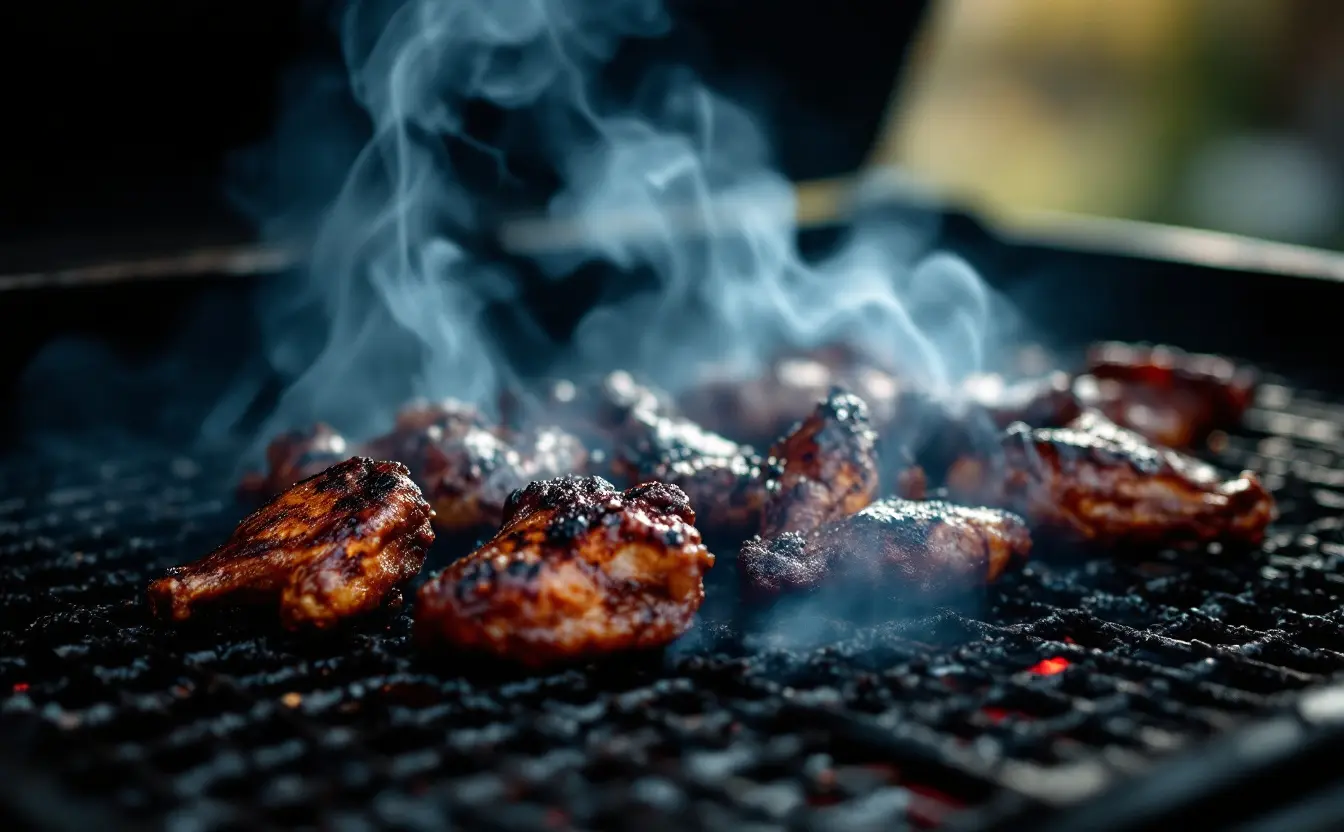
Smoked chicken wings have one problem, and it's the skin. Pull them off a 225°F (105°C) smoker after two hours and they look fantastic, glossy and mahogany, and then you bite into something with the texture of a bike inner tube. No sauce fixes that. The good news is that the problem is predictable and so is the cure. I treat smoke and crunch as two separate jobs: the smoker handles flavour, then a few minutes of high heat handles the skin.
The short version: dry brine the wings overnight, smoke them at 275°F (135°C) for 75 to 90 minutes over a mild wood like apple or cherry, then finish them for 5 to 10 minutes at 425°F (220°C) or over hot coals until the thickest pieces read 175 to 190°F (79 to 88°C).
At a glance
| Pit temperature | Smoke time, thawed wings | Smoke flavour | Skin before the finish |
|---|---|---|---|
| 225°F (105°C) | 2 to 2 1/2 hours | Strongest | Soft and rubbery |
| 250°F (120°C) | 1 1/2 to 2 hours | Medium | Soft |
| 275°F (135°C) | 1 1/4 to 1 1/2 hours | Lighter but clear | Firmer, starting to render |
- Yield: 3 lb (1.4 kg) of party wings, about 25 to 30 pieces
- Wood: apple, cherry, pecan or maple
- Finish: 5 to 10 minutes at 425°F (220°C), or over direct heat
- Done: 175 to 190°F (79 to 88°C); 165°F (74°C) is the safe minimum
- Rest: 5 minutes before saucing
The times are for one batch in a single layer, not per pound. Three pounds and six pounds take about the same time, as long as the wings aren't stacked and the smoker holds its temperature.
Dry brine the night before
For 3 pounds (1.4 kg) of wings:
- 1 tablespoon kosher salt (or 1 1/2 teaspoons fine table salt)
- 1 tablespoon aluminum-free baking powder
Pat the wings dry, toss them with the salt and baking powder until evenly coated, and lay them skin side up on a wire rack set over a sheet pan. Refrigerate them uncovered for 8 to 24 hours. The salt seasons the meat and draws moisture to the surface, where the cold, dry air of the fridge carries it off. By morning the skin is tight, slightly translucent and tacky to the touch. The baking powder earns its place later, during the hot finish, when it helps the skin brown and blister.
Skip the wet brine. Soaking wings in salt water seasons them well enough but loads the skin with water, which is the opposite of what a smoker needs.
A rub that survives the finish
The brine already salted the wings, so this rub has none. Keep sugar to a minimum, because the hot finish will scorch it.
- 1 tablespoon sweet paprika
- 2 teaspoons coarsely ground black pepper
- 1 teaspoon garlic powder
- 1 teaspoon onion powder
- 1 teaspoon dry mustard
- 1/2 teaspoon ground cumin
- 1/4 to 1/2 teaspoon cayenne
- 1 teaspoon brown sugar, at most
Sprinkle it on just before the wings go in the smoker. A light, even coat is enough; you should still see skin through it.
How to smoke chicken wings, step by step
- Bring the smoker up to temperature. I run 275°F (135°C) for wings. Let it settle for 15 to 20 minutes once it gets there, and wait until the smoke leaving the stack is thin and pale blue rather than thick and white.
- Lay the wings on the grate in one layer, skin side up, with a little space between pieces. Put the drumettes toward the hottest part of your smoker and the flats toward the coolest.
- Close the lid and leave it. Wings don't need turning, and every peek dumps heat and adds time.
- Start checking with an instant-read thermometer about 15 minutes before the low end of the time range. When the thickest drumettes read 165 to 175°F (74 to 79°C), they're ready for the finish.
- Finish hot for 5 to 10 minutes (see below) until the skin is crisp and the wings read 175 to 190°F (79 to 88°C).
- Rest them for 5 minutes, then sauce them or serve them dry.
To plan the cook backwards from tip-off, the smoker time calculator lists chicken wings with the same times for each pit temperature, plus the rest.
Choosing a pit temperature: 225, 250 or 275°F
225°F (105°C) gives the deepest smoke and the longest cook, 2 to 2 1/2 hours. It also gives the softest skin, because at that heat the fat underneath barely renders. Choose it if smoke is the whole point and you're committed to a hard finish.
250°F (120°C) is the middle road at 1 1/2 to 2 hours. Plenty of smoke, still soft skin.
275°F (135°C) is my default. Wings are small, with a lot of surface for their size, so they take on smoke quickly, and 75 to 90 minutes is enough for a clear smoky flavour. The fat starts rendering, the skin goes into the finish already firmer, and the whole cook fits between the end of the early game and the start of the late one.
Your smoker gets a vote too. Many electric smokers top out at about 275°F, and on a cold Canadian evening they can struggle to hold it, so a 250°F cook with a longer finish may be the realistic plan. The electric smoker guide has a section on smoking in cold weather. Pellet grills hold 275°F easily and can climb much higher for the finish without the wings ever leaving the grate, which suits this method well; pellet grills explained walks through how they work and why their smoke gets lighter as the heat goes up.
Which wood for smoked chicken wings
Wings take on most of their smoke early, while the surface is still cool and damp, and their small size means a little goes a long way. A strong wood that suits a 12 hour pork shoulder will turn a wing bitter.
- Apple: mild and slightly sweet, my everyday choice.
- Cherry: mild, and it deepens the skin to a dark reddish mahogany.
- Pecan: a bit richer and nuttier, like a gentler hickory.
- Maple: mild and sweet, and easy to find in Canada.
- Hickory: fine in small doses or mixed half and half with a fruitwood. On its own it can take over.
- Mesquite: skip it for wings. It's harsh at this scale.
On a charcoal smoker, two or three fist-sized chunks are plenty. In an electric smoker, add a small handful of chips at a time, once or twice in the first hour. On a pellet grill, use fruitwood pellets or a mild blend. Thick white smoke means the wood is smouldering instead of burning cleanly, and it leaves an acrid coating on the skin. Open the vents and wait for it to clear before the wings go on.
Why smoked wings go rubbery, and how to fix it
Chicken skin is mostly water, fat and collagen. To turn crisp, the water has to evaporate and the fat has to render out. At 225 to 250°F (105 to 120°C), especially in a smoker with a water pan steaming away, neither happens fast enough. The skin cooks through and goes leathery and chewy instead of drying out and shrinking tight.
Most of the prevention is already in this recipe: the dry brine with baking powder, a 275°F pit, and no water in the water pan for wings. Don't spritz or mop them either. That only puts water back on the skin.
The fix is a short blast of high heat at the end. Any of these works:
- Oven: move the wings to a rack over a sheet pan in a 425°F (220°C) oven for 5 to 10 minutes.
- Charcoal grill: spread the wings over hot coals and turn them every minute or so for 5 to 10 minutes. Move pieces to the cool side if dripping fat causes flare-ups.
- Pellet grill: turn it to its highest setting as the wings approach 165°F (74°C). It takes a few minutes to climb, then give them 5 to 10 minutes at the top.
- Deep fryer: about 2 minutes in 375°F (190°C) oil gives a fried crust over real smoke. The fried, baked and smoked wing comparison covers that version.
You'll hear it before you see it. The skin starts to sizzle and pop as the last of the fat renders, then it tightens, small blisters rise and the thin edges of the flats go dark gold. That's the moment to pull them.
Smoked wings temperature: 175 to 190°F inside
Two numbers matter. Chicken is safe at 165°F (74°C), the figure the USDA and Health Canada give for poultry pieces. But wings are full of connective tissue, and at 165°F the meat still clings to the bone with a slight chew. Somewhere between 175 and 190°F (79 to 88°C), that collagen softens into gelatin and the meat comes away in one bite.
Smoked wings are forgiving here. The gentle heat gives you a wide window, and a wing that comes off the smoker at 185°F (85°C) is still juicy. Probe the thickest drumette in the middle, not touching the bone, which reads hot. Flats get there first; if they're well ahead, move them to the finish early.
Saucing smoked wings
Smoke is subtle, and a thick, sweet sauce buries it. Go light.
Alabama-style white sauce
This is the classic partner for smoked chicken. Whisk 1/2 cup (125 ml) mayonnaise with 2 tablespoons apple cider vinegar, 1 teaspoon prepared horseradish, 1 teaspoon coarse black pepper, 1 teaspoon lemon juice and a pinch of cayenne. Serve it on the side for dipping, or toss the wings in half of it. Make it a few hours ahead so the horseradish has time to settle in.
Thin Buffalo, or nothing
If you want Buffalo, go easy on the butter so the sauce stays thin and the smoke comes through. Or skip sauce altogether: the rub, a squeeze of lemon and a few flakes of salt let the smoke do the talking. If you want a sticky glaze, brush it on during the last 2 to 3 minutes of the hot finish, never before, and stay close.
FAQ
How long do you smoke chicken wings?
At 275°F (135°C), 75 to 90 minutes; at 250°F (120°C), 90 to 120 minutes; at 225°F (105°C), 2 to 2 1/2 hours. Add 5 to 10 minutes for the hot finish. Wings are done by temperature, 175 to 190°F (79 to 88°C), not by the clock.
Can you smoke frozen wings?
No. At smoker temperatures, frozen wings spend too long in the range where bacteria multiply before they heat through. Thaw them in the fridge first, and use the time for the dry brine.
Do I need a water pan for smoked wings?
No. A water pan keeps the air humid, which helps big cuts on long cooks and works against crisp skin on a short one. Leave it empty for wings.
Can I get crispy smoked wings without a hot finish?
Not truly crisp, at these pit temperatures. A dry brine with baking powder and a 275°F (135°C) pit will give you firm skin you can bite through cleanly, and some people are happy there. For real crackle you need those 5 to 10 minutes of high heat.
Can I smoke wings ahead of game day?
Yes. Smoke them until they reach at least 165°F (74°C), cool them, and refrigerate them covered for up to 3 days. Before serving, finish them on a rack in a 425°F (220°C) oven for about 12 to 15 minutes, until the skin crackles and the centre is back to at least 165°F. Smoke on Saturday for a Sunday game, and the only job left on game day is a quarter of an hour with the oven on.