How to Read a Basketball Game From a Bar Stool
The sound is off, the room is loud and the ball moves too fast. Here is what to watch instead, possession by possession, from any seat.
By Andre Whitfield9 min read
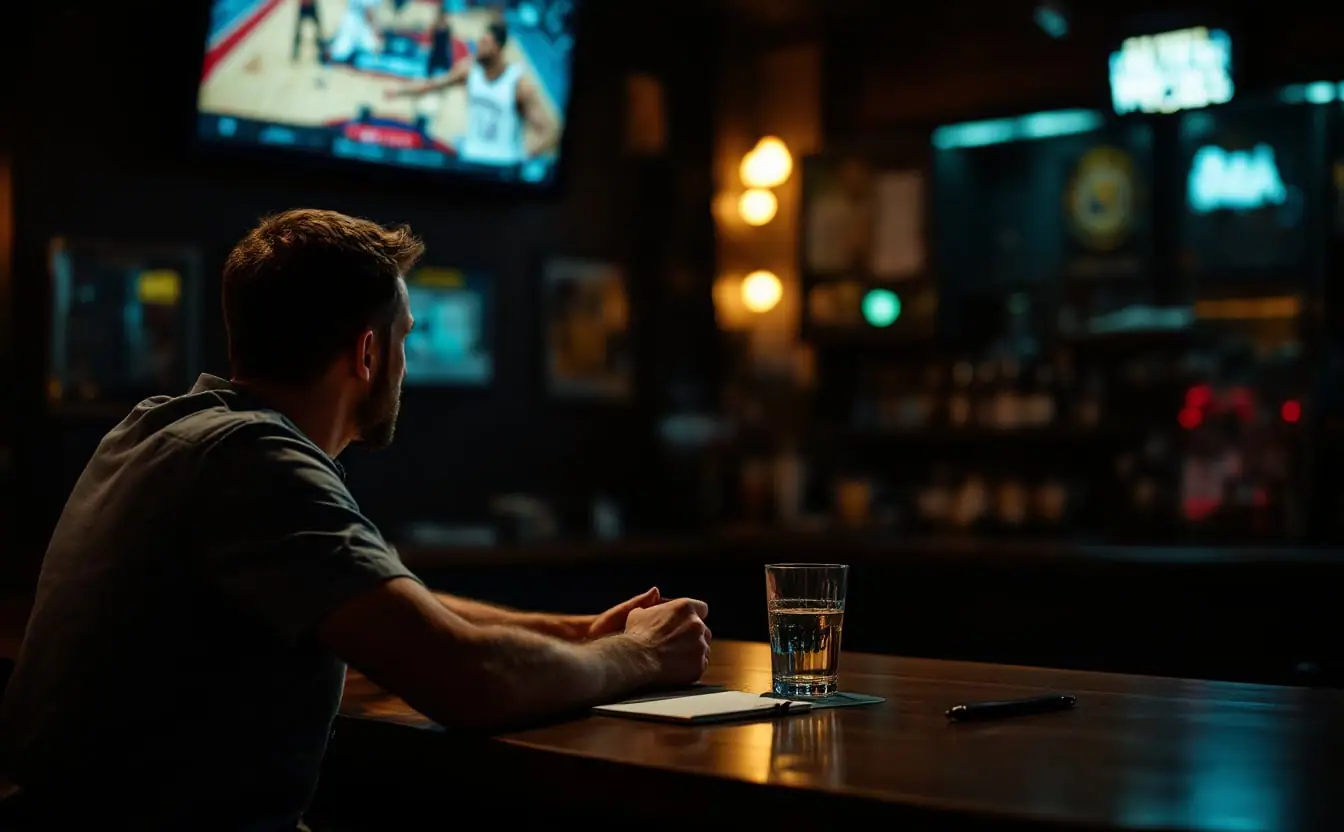
Most of the basketball I have watched since university has been on a screen bolted above someone else's head. The sound is off or buried under a playlist, there is a hockey game on the set beside it, and the person on the next stool wants to talk about his brother-in-law's truck. You can still read a game in that room. You just have to stop doing the thing everyone does, which is follow the ball.
I played club ball through university in Ontario, and I was never good enough to stop thinking on the floor. That habit turned into a notebook. For years I have charted games in a spiral pad, usually from a seat with a clean sightline, which matters more than the size of the screen (the guide to what makes a good room for a game covers sightlines properly). What follows is the short version of what goes in that notebook.
Give the ball a rest for three possessions
The ball is the least interesting thing on the floor most of the time. Everyone in the building is looking at it, including the defence, and that is exactly why the action happens somewhere else.
Try this in a quiet stretch. For three straight possessions, do not look at the player with the ball. Pick the player in the weak-side corner, or the centre who just set a screen, and watch only him. You will see screens set away from the ball that the broadcast never mentions. You will see a defender turn his head for half a second and a cutter go right behind him. You will see who stands still, and on most teams that tells you who the coach does not trust to make a decision.
Three possessions is enough. Go back to the ball after that, and you will find you see the cuts coming.
Count the passes
This is the simplest thing I do and the one I would give up last. Every possession, I count passes before the shot. A tally on a napkin works fine.
The count is not a grade. A one-pass possession can be perfect: a guard gets downhill, the defence collapses, he kicks it out and the shooter is wide open. But the pattern over a quarter tells you a lot. A team moving the ball four or five times a trip is usually making the defence rotate, and rotating defences give up open looks eventually. A team whose count drops to zero and one in the last six minutes has usually decided to let its best scorer go one-on-one. Sometimes that works. When it does not, you will have seen it coming on your napkin before the commentators start talking about stagnation.
Find the player the defence is hiding
Every defence has a weakest link, and every coach tries to hide him. The usual move is to put him on the opponent's least dangerous player: a centre who does not shoot, or a wing who rarely looks at the basket.
You can spot this at the first dead ball of each quarter, when the camera widens and players point at each other to sort out matchups. Write down who is guarding whom. Then watch what the offence does about it. Good teams go hunting. They have the player being guarded by the weak defender come up and set a screen, so the weak defender is dragged into the action whether his coach likes it or not. When the same two players run the same screen four times in a row, that is not a lack of imagination. It is a target.
The shape of the floor
Spacing sounds like coaching jargon, but you can see it from across a room. When an offence is set, picture five spots: the two corners, the two wings and the top of the key. Add the short stretch of baseline beside the basket, which coaches call the dunker spot, where a big man waits for a dump-off pass.
Now count how many offensive players are outside the three-point line. Four out and one in is common. Five out, with even the centre standing at the arc, pulls every defender away from the basket and opens the driving lanes. When two offensive players drift within a few steps of each other, one defender can guard both, and the floor shrinks.
The other half of the picture is the paint. When the ball is on a wing, count the defenders standing in it. Two or three means the defence is packing it in and daring the offence to shoot. One means it is staying home on shooters, and somebody with a quick first step is about to try his luck at the rim.
After a miss, look up the floor
When a shot misses, almost everyone in the room watches the rebound. Look the other way, at the far end of the floor, and count who is already back.
Made baskets give a defence time to set up. Misses, especially long rebounds that bounce out past the free-throw line, let the offence run before the defence is organized. Watch the first two or three seconds. Who sprints back, and who stops to complain to the referee? In transition, defenders often grab whoever is nearest rather than their own man, which is how a point guard ends up on a centre for a full possession. The smart offence spots that cross-match and throws the ball inside before anyone can switch back.
Teams that win these moments tend to win runs. Three quick baskets, a crowd on the screen jumping, and somebody near you says the other team looks tired. Often they are just late getting back.
Timeouts tell you what a coach saw
Some stoppages are scheduled for television and arrive on a fairly regular rhythm. Those tell you little. The other kind is a coach calling timeout because something is going wrong, usually after the other team has scored several baskets in a row.
When a coach burns one, write down the score and the time, then watch the first possession after it. Coaches draw up specific plays in those huddles, and the after-timeout play is often the cleverest thing a team runs all night: a double screen for a shooter, a back cut that only works once. Then watch the next defensive trip. Did the team change who guards the opposing star? Did it go to a zone? A timeout is a coach admitting what worried him, and the next two minutes usually show you what it was.
Foul trouble and the rotation clock
In the NBA a player is gone after his sixth personal foul. In international play and the US college game it is the fifth. Either way, a starter who picks up two fouls in the first quarter almost always goes to the bench, and the game you were watching changes.
The scorer's table is your friend here. Players waiting to check in crouch or stand beside it, so you can often spot a substitution before the whistle. In my notebook I draw a line every time a lineup changes and write the score at that moment. Over a game, the coach's pattern appears: when the starters come out, whether the bench unit holds its own, whether the two best players are staggered so one is always on the floor.
Team fouls tell a story as well. Once a team piles up enough fouls in a quarter it is in the penalty, and every defensive foul after that sends somebody to the line. The score bug usually flags it with a "bonus" tag. A defence in the penalty with four minutes left in a quarter has to play softer, and good guards know it.
The shot clock is a story in three acts
The NBA, the WNBA and international basketball use a 24-second shot clock; the US college game uses 30. In the NBA and FIBA game, an offensive rebound gives the offence a fresh 14 seconds rather than the full count. Whatever the league, most possessions fall into three parts.
- Early clock: transition, or a quick hit before the defence gets settled.
- Middle clock: the called play. Screens, cuts, the actual design.
- Late clock, under about seven seconds: the play has usually failed, and the ball goes to whoever the team trusts most to make something out of nothing.
That third act is the one to watch. Who gets the ball with five seconds left tells you more about a team's pecking order than any pre-game graphic. And from the other side, forcing a contested shot as the clock runs out counts as a possession won, even when the shot goes in.
What the camera hides
The main broadcast camera sits high at centre court and follows the ball. It frames roughly the half of the floor the ball is on, so the weak-side corner is often at the edge of the picture or off it entirely. That is why a corner shooter so often seems to appear from nowhere on a kick-out. He was standing there the whole time. The camera just was not looking at him.
You can work around it. Free throws are your best window: the shot is wide and still, and you can see all ten players and where they stand. Replays often use a reverse angle or a camera behind the basket, and those show the defensive rotation the live shot missed. When a replay runs, ignore the dunk and find the help defender who arrived late.
When the sound is off
In a loud room you are watching a silent film, so read the parts of the picture that talk.
- The score bug: score, quarter, game clock, shot clock, timeouts left and the bonus flag. Check it every possession.
- Referee signals. One arm up with three fingers means a three-point attempt; both arms up means it went in. Rolling fists means travelling. Hands on hips means a blocking foul.
- The benches. A bench that stands before the ball reaches the rim knows something about the shot.
- Captions. If it is your own screen, turn them on. They lag, but they catch the names.
The room is a signal too. A crowd of fans reacts a beat before you register what happened: the groan as a bad pass leaves a player's hands, the rising noise as a shooter gets his feet set.
One page per quarter
If you want to try the notebook, keep it small. Here is one page of mine:
- The quarter, the score and the five players on the floor for each team.
- Pass counts, as tally marks, one row per possession.
- A rough half-court sketch with a dot for each shot, filled in if it went in.
- A note every time the matchup on the opposing star changes.
- The time and score at every timeout, with a word about what changed after it.
There is more on tactics over on the basketball beat, and the sporting calendar will tell you when the games that reward this kind of attention come round. But all you need to start is a pencil, a seat where you can see the whole screen, and the discipline to look away from the ball for three possessions. The first time you call the back cut before the pass is thrown, you will point at the screen. The person beside you will assume you are excited about the score.