Why We Watch Together: The Social Life of the Sports Bar
Strangers high-fiving, regulars guarding their stools, a room cheering half a second late. What really happens when we watch a game together.
By Priya Nair9 min read
The first time a stranger lifted me off the floor, it was a weeknight in May and neither of us knew the other's name. A three dropped with a few seconds left, the room went up, and a man in a loosened work tie who had been standing behind my stool for most of the second half caught me under the elbows, hoisted me a few inches, set me down and went back to his drink. We never spoke. I couldn't pick him out of a crowd today. I do remember that his tie was green, and that for about four seconds he was the person I trusted most in the city.
I have spent a lot of nights since then trying to work out what happened in that moment, and in the rooms where it keeps happening. I've hosted more playoff parties than my landlord would like to know about, watched finals in packed bars and empty ones, and stood in public squares with crowds I'll never see again. This is my best attempt at explaining why we bother, when the picture at home is better, the beer is cheaper and nobody spills anything on your shoes.
A third place with a scoreboard
In 1989 the sociologist Ray Oldenburg wrote a book called The Great Good Place about what he called third places. Home is the first place and work is the second. The third places are the cafés, taverns, barbershops and corner stores where people turn up without an invitation, where regulars set the tone, where your job title matters less than being decent company, and where conversation is the main thing going on.
A sports bar on game night bends that last rule. The main thing going on is the game, and conversation happens around it, in the gaps: timeouts, free throws, the long minute while the officials stare at a replay monitor. But I'd argue the game makes the room more of a third place, not less. It gives people who have nothing else in common something to say.
The urbanist William H. Whyte, who spent years filming how people used plazas in New York, had a word for this. He called it triangulation: something outside two strangers, a street performer or an odd sculpture or a dramatic view, that gives them a reason to talk to each other as if they weren't strangers at all. A basketball game is triangulation on a schedule. You don't need an opening line. The opening line just happened on the screen, and everybody saw it.
The high five
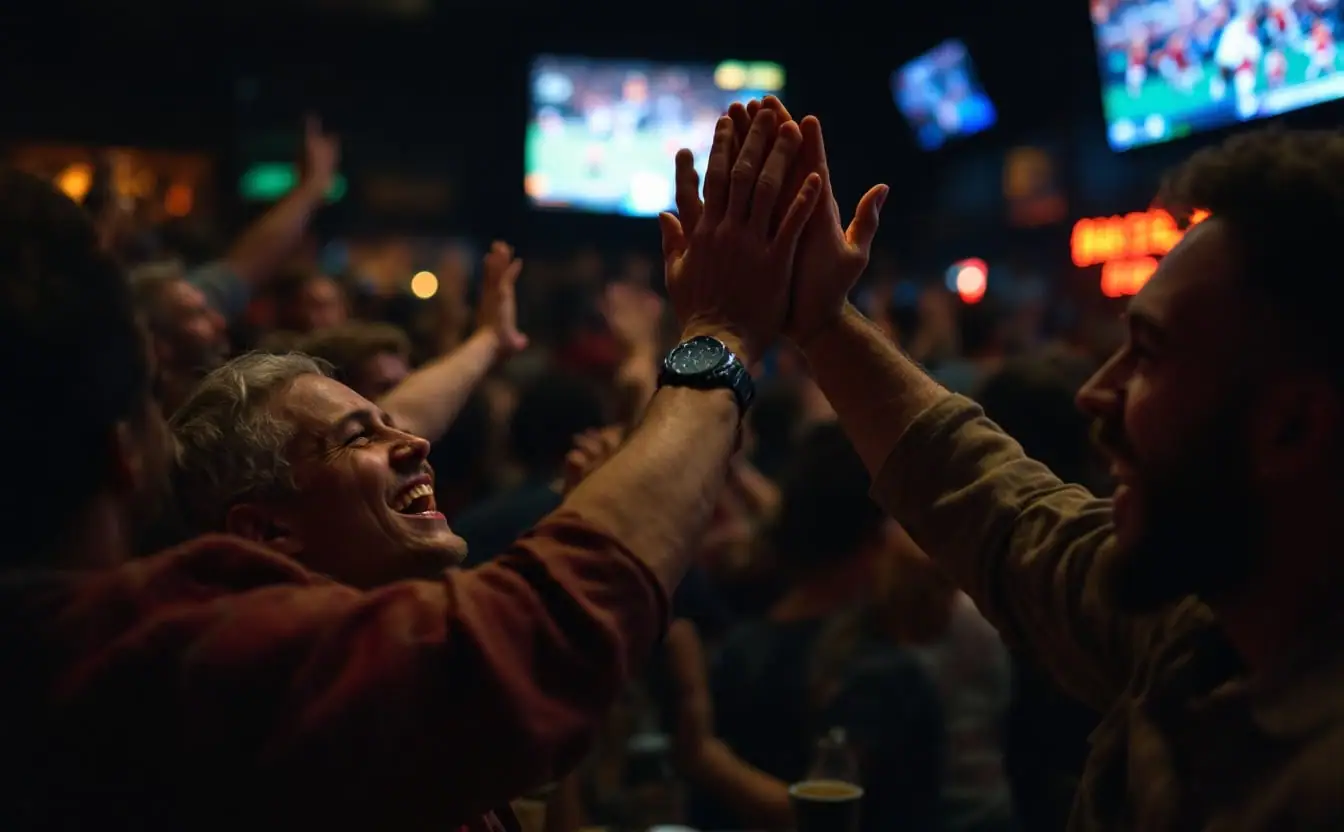
Watch a room after a big shot and you'll see a small, strange social contract play out. People who would never touch a stranger on the subway are suddenly slapping palms with the person at the next table. The window is short. A high five that comes a second too late is awkward. One that lands on time feels like you've known each other for years.
There are rules nobody wrote down. You offer a hand at about shoulder height and let the other person decide. You don't high-five someone in the other team's jersey unless they offer first, and if they do, you take it. Some people hug. Some people just turn to the nearest face with their mouth open and say nothing, which counts.
What moves me about it is how brief it is. Thirty seconds later everyone is back in their own conversation, their own order, their own life, as if the contact never happened. The room made a decision together and then let everybody go.
Rituals, superstitions and the friend who has to leave
Every room I've watched in has its rituals, and most of them make no sense, which is the point. A man I sat near through an entire playoff run wore the same unwashed cap for six weeks and kept it in a sealed freezer bag between games. A group of friends at one of my parties made someone stand in the hallway for a whole quarter because the team went on a run the first time she went to the bathroom. People switch seats when a lead is shrinking and switch back when it grows. Nobody, in any room I've ever been in, says out loud that a lead is safe.
I have my own. I won't say what they are, partly because I'm embarrassed and partly because saying them out loud might break them.
I don't think any of us believe these things change the score. What they change is the waiting. When you care about something you can't control, a ritual gives your hands and your nerves a job. It also gives the room a shared language. The friend in the hallway becomes a story the group tells for years, and she's the hero of it if they won.
The regulars
Every good room has a few people who were there before you and will be there after. They know which stool has a clear view past the pillar, which screen runs a beat behind the others, and which server will turn the sound up without being asked. They remember the game from three seasons ago that everyone else has forgotten, and they'll tell you about it during a timeout whether you asked or not. The best of them can call a team's next set before the point guard crosses half court, the kind of thing Andre Whitfield explains in his piece on reading a basketball game from a bar stool.
Regulars are the room's memory and, quietly, its referees. A new crowd learns the house rules by watching them: when it's fine to stand, when to hush for free throws, how loud is too loud on a Tuesday in November. When a regular stops showing up, the staff notice, and so does everyone else, even the people who never knew his name.
Two jerseys, one room
Rival fans in the same room are a test, and most rooms pass it better than you'd expect. The visiting fan who cheers for her own team, loudly and fairly, usually ends the night with a few new friends and maybe a round bought by the people who beat her. The one who cheers against the room, needling the table next to him after every basket, gets frozen out without anyone raising their voice.
A room polices itself. There's a shared sense of how far you can push it. A little chirping is part of the fun. Celebrating in someone's face is not. The best nights I've had in mixed rooms ended with the losing side holding the door for the winners, and both groups agreeing the officiating had been terrible.
The half-second problem
Here is something you only notice once you start paying attention. In a lot of rooms, not every screen is showing the same moment. One television is on a cable feed, another is plugged into a streaming box, and the projector on the patio is running through somebody's laptop. The gap between them can be a fraction of a second or it can be much longer. So the patio cheers, the people at the bar turn around confused, and then the shot goes in on their screen too and they cheer for something that already happened.
Phones make it stranger. Score alerts often arrive ahead of the broadcast, so you'll see someone glance at their pocket and go pale before the play has even developed. At home it's the neighbour through the wall, or the group chat lighting up with a single word while your stream is still showing a free throw.
A room that's all on one feed cheers once, together, and it is one of the best sounds in sports: a held breath, then a single crack of noise that hits the back wall and comes back. A room split across feeds cheers in a ragged roll, front to back, like a stadium doing the wave by accident. Both are memorable. Only one of them feels like the whole room saw it at the same time.
What a good room does
I've watched in rooms that made big games feel bigger and rooms that made them feel like background noise. The difference is rarely the size of the screens. It's things like these:
- Every seat can see a screen without anyone turning their chair around.
- For the big game, one screen gets the sound and everybody knows which one.
- Every screen is on the same feed, so the room reacts at once.
- The other screens run captions instead of competing audio.
- There is space to stand in the last two minutes, because people will.
- Staff know the schedule and don't flip a channel during a commercial.
None of that is expensive. All of it takes somebody caring. There's more on sizing up a room before you sit down in our guide to what makes a good place to watch, and the photo essay on watching spaces shows what good sightlines look like in practice.
Alone on the couch
I watch plenty of games at home, and I won't pretend it's worse in every way. The picture is better. You can pause for the kettle. You choose the food, and nobody's elbow is in your nachos.
What home can't give you is the second after. A big shot goes in and the feeling has nowhere to go. You say something to the empty room, or to the dog. You reach for your phone, and the group chat becomes your room, which works until somebody with a faster feed spoils the ending by eight seconds. The whole experience gets squeezed into a screen inside a screen.
I know people who keep the radio call playing in the kitchen just to have another voice in the house. We're trying to rebuild the room out of whatever we have to hand.
The biggest rooms
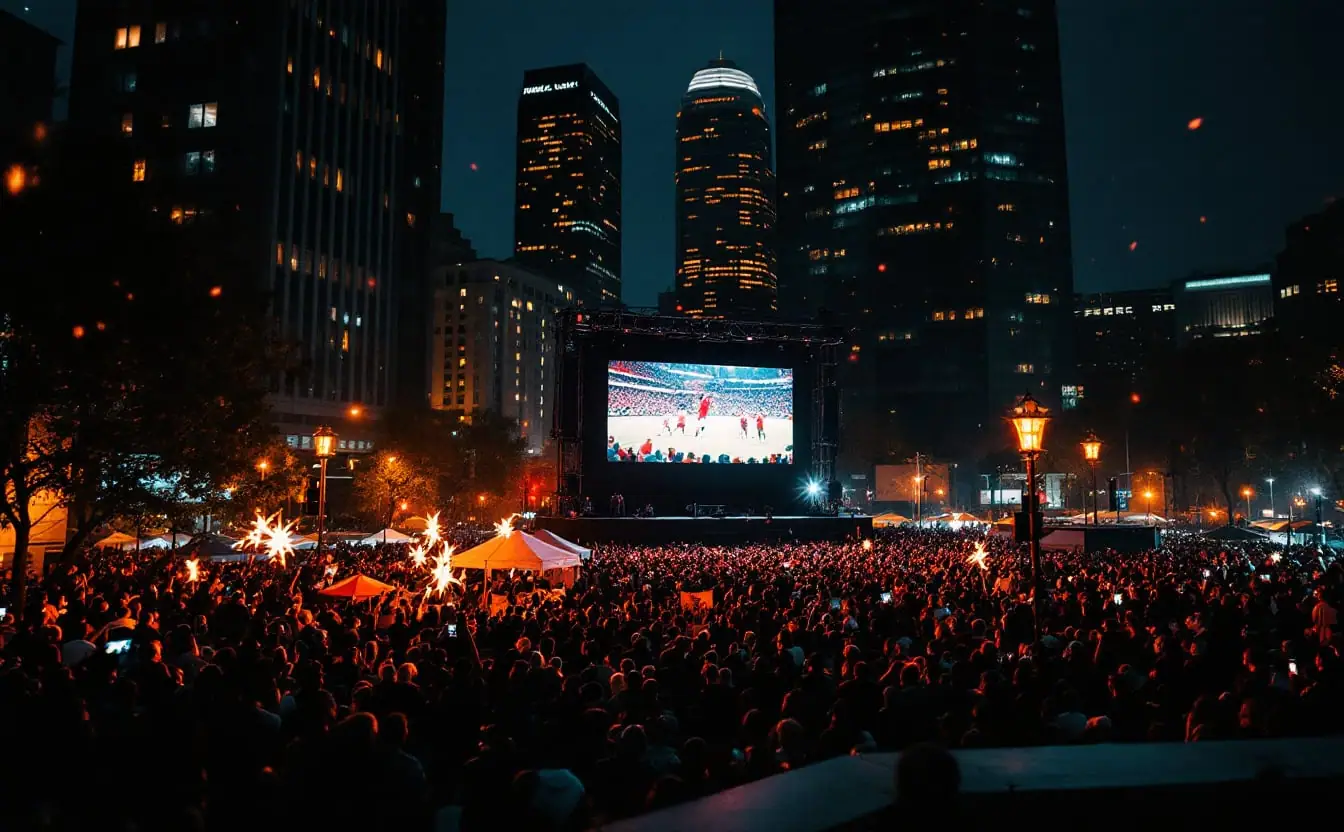
Public squares are the extreme version of all this. The crowds outside Toronto's arena during the 2019 playoffs, in the square fans called Jurassic Park, became the most famous example in Canada, but every big tournament now produces its own: fan zones at World Cups, screens set up in plazas and parking lots for finals, outdoor watch parties in towns too small to have an arena.
In those crowds you can't always see the screen. You watch the people in front of you watch it, and you react to them. The sound arrives in layers, from the speakers first and then from the crowd, slightly out of step. When it rains, strangers share umbrellas and nobody leaves. It's the third place at full scale, with no stools, no regulars and no one in charge, and somehow it still holds together.
A napkin with tally marks
The night that stays with me most from all these years was not a championship. It was a second-round game in a half-full room on a cold night, nothing special on paper. Sometime in the second quarter a man at the end of the bar started keeping count of made threes on a paper napkin, one column for each team, little bundles of four lines with a slash through them. People drifted over to check his count during timeouts. A server added a mark for him while he was in the washroom. By the fourth quarter, three tables were invested in a napkin.
When the game ended, he left it on the bar under his empty glass and walked out into the cold. I picked it up before it got wiped away. The ink had bled a little where the glass had sweated on it, and someone, not him, had circled the home team's final count twice.