Garlic Parmesan Wings That Cling: Butter, Real Cheese and the Two-Step Toss
Garlic parmesan wings with a sauce that clings instead of pooling: butter or oil, real parmesan over pre-grated, and a toss that keeps the skin crisp.
By Megan Tremblay10 min read
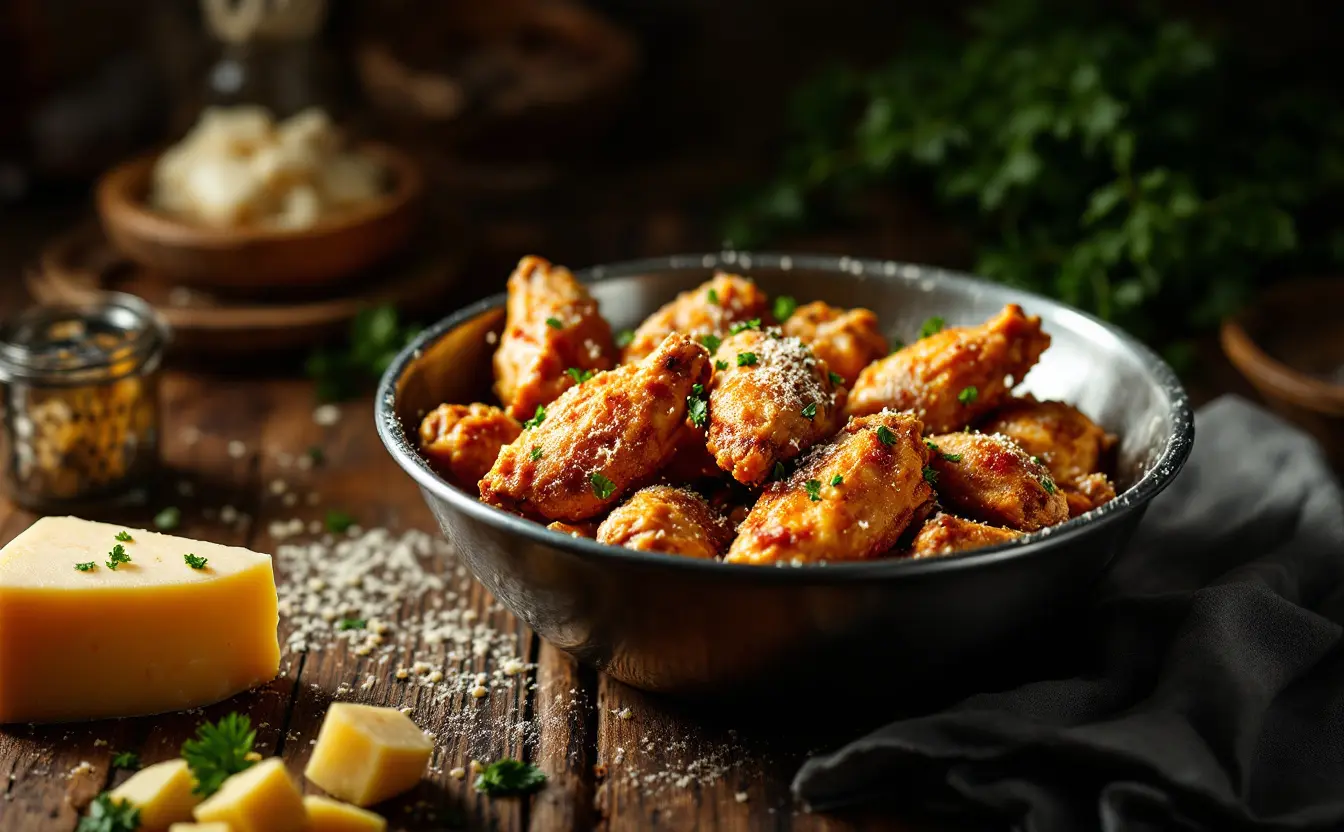
Garlic parmesan wings are the order from every table that doesn't want heat, and by late November, with a game on somewhere every night of the week, that's a lot of tables. They're also the wing most often done badly: butter pooled in the basket, cheese fused into damp clumps, garlic either raw and harsh or brown and bitter. I fried plenty of them on a pub line, and nearly every problem comes back to three things: how much fat is in the sauce, which cheese you grate, and the moment the wings meet both.
The method in one breath: cook the wings until they're properly crisp, toss them while still hot in a small amount of warm garlic butter, then dust on freshly grated parmesan in a second, separate toss, and get them to the table within ten minutes. Two tablespoons of fat per pound of wings is the ceiling. Go past it and the wings go greasy, every time.
At a glance
| What | Details |
|---|---|
| Yield | 2 lb (900 g) party wings, about 18 to 20 pieces |
| Garlic butter | 4 tablespoons (55 g) fat in total, 4 garlic cloves |
| Cheese | 40 g (1 1/2 oz) parmesan, grated from a wedge |
| Baked | 425°F (220°C), 35 to 45 minutes on a rack, turned once |
| Air fryer | 400°F (205°C), 18 to 22 minutes, shaken every 6 to 7 minutes |
| Deep fried | 375°F (190°C) oil, 8 to 10 minutes |
| Done | 175 to 190°F (79 to 88°C) in the thickest piece; 165°F (74°C) is the safe minimum |
| Toss | Within 2 minutes of the wings leaving the heat |
The cooking times match the chicken wing cooking times tool, which also covers the smoker and the grill.
Ingredients
For the wings:
- 2 lb (900 g) chicken wings, split into drumettes and flats
- 2 teaspoons kosher salt, or 1 teaspoon fine salt
- 2 teaspoons aluminum-free baking powder, if you're baking or air frying
- 1/2 teaspoon garlic powder
For the garlic parmesan coat:
- 3 tablespoons (40 g) unsalted butter
- 1 tablespoon (15 ml) olive oil
- 4 garlic cloves, grated on a rasp or minced very fine
- 1/2 teaspoon coarsely ground black pepper
- 1/4 teaspoon red pepper flakes (optional)
- Finely grated zest of half a lemon (optional)
- 40 g (1 1/2 oz) parmesan from a wedge, which is about a loose 1/2 cup from the fine holes of a box grater, or roughly a cup of fluffy shreds from a rasp
- 2 tablespoons finely chopped flat-leaf parsley
For a bigger group, the wings calculator works out how many pounds to buy. It plans 1/4 cup of tossing sauce per pound, which is right for Buffalo. For garlic butter, make about half that. It's nearly all fat, and a little covers a lot of wing.
How to make garlic parmesan wings
- Cook the wings until the skin is deep golden and firm. The baking powder method in baked chicken wings and the batch plan in air fryer chicken wings both work well, and so does frying. Pale, soft skin turns greasy under any butter sauce.
- While the wings cook, put the butter and oil in a small saucepan over low heat. Once the butter has melted and the foam settles, add the garlic and cook it gently for 2 to 3 minutes, swirling the pan, until it smells sweet and the raw bite is gone. It should stay pale. If the edges start to turn gold, take the pan off the heat right away.
- Off the heat, stir in the black pepper, chili flakes and lemon zest. Hold off on salt. The parmesan is salty and so are the wings.
- Grate the cheese into a dry bowl and leave it at room temperature. Cold cheese clumps the moment it touches warm butter.
- Warm a large metal mixing bowl under hot tap water and dry it well.
- Move the wings into the bowl within a minute or two of finishing, while they're still faintly sizzling. Pour in about two thirds of the garlic butter, down the side of the bowl rather than over the top, and toss with a few flips of the wrist until every piece looks glossy. Add the rest only where you see dry patches.
- Scatter over a third of the cheese and toss. Repeat twice more. You're after a fine, even coat that softens a little on contact without melting into puddles.
- Add the parsley and a last pinch of cheese over the top, then taste a flat. Salt now only if it needs it, and serve.
Garlic parmesan wing sauce: butter, oil or both
Butter brings the flavour people expect, but it isn't pure fat. Roughly a sixth of it is water, plus milk solids. The water is what softens skin. The milk solids are what make the sauce taste like good garlic bread, and they give the cheese something tacky to grip. Butter also firms up as it cools, so an all-butter coat turns waxy on wings that sit around.
Olive oil has no water, so it's kinder to crisp skin, and it stays fluid at room temperature. The trouble is that it runs. It slides off the wing and collects in the bottom of the bowl, the cheese has less to hold onto, and the whole thing tastes thinner.
| Base | Flavour | Cling | Crisp skin | Notes |
|---|---|---|---|---|
| All butter | Richest | Good warm, waxy once cool | Fair | The classic; serve fast |
| All olive oil | Lighter, fruity | Runs off | Good | Cheese grips poorly |
| 3 parts butter, 1 part oil | Rich | Best | Good | My default |
| Ghee or clarified butter | Nutty, toasted | Good | Best | No water, less fresh dairy taste |
The butter and oil blend is where I landed after a lot of batches. The oil keeps the butter fluid for a few more minutes on the plate, and there's still enough dairy for it to taste right. Ghee is the better choice when wings have to wait on a buffet table, since it has no water to soften anything, but it tastes toasted rather than fresh.
Whichever base you use, never let it boil. Hot butter can split into clear fat and milky liquid, and a split sauce coats nothing. And keep the amount small; with well-rendered skin you'll often need less than the two-tablespoon limit.
One food safety point. Garlic sitting in oil at room temperature is a known botulism risk, so make the sauce fresh, use it the same day, and refrigerate any leftover right away instead of leaving a jar on the counter.
Real parmesan or pre-grated?
This is the biggest swing in the whole recipe, and it costs five minutes of grating.
Shelf-stable grated parmesan, the kind sold in a shaker, is very dry and usually has an anti-caking agent mixed in, often cellulose. It doesn't soften on a hot wing. It sits there like seasoned sand and most of it ends up in the bottom of the bowl. Bagged refrigerated shreds are better cheese, but they carry an anti-caking coating too, and the strands are thick enough to bounce off the wing.
A wedge grated just before the toss behaves differently. Fine, fluffy shreds still hold a little moisture and fat, so they soften the moment they meet warm butter and cling in a thin, savoury coat. They taste nuttier as well.
- Parmigiano Reggiano gives the deepest flavour and grates the finest. A rasp turns 40 g into a small snowdrift that coats every crease.
- A good domestic parmesan works well for less money. Look for a hard wedge with a dry rind.
- Grana Padano is milder and softer, and melts onto the wing a little more readily.
- Pecorino Romano is saltier and sharper. Use it for a third of the cheese at most, and skip the final pinch of salt.
Grate it fresh, on a rasp for a fine coat or the fine holes of a box grater for small flecks. Cheese grated an hour early dries out and starts behaving like the shaker kind.
Timing the toss
Most greasy garlic parmesan wings were tossed at the wrong moment.
Too early, straight out of the oil or oven, and the wings are still pushing steam and fat out from under the skin, which softens the coat from the inside and thins the sauce. Too late, and the skin has cooled, the butter sets in patches and the cheese sits on top like dust. The window is roughly the first two minutes after the wings have drained, while they're still sizzling quietly.
The sauce has its own window. It should be warm and fully liquid, about the temperature of a hot bath, never bubbling. If you made it early, rewarm it over the lowest heat for a minute and stir. If it's too hot when the cheese goes on, the parmesan turns oily and stringy.
Keep the two tosses separate. Stirring the cheese into the butter on the stove looks like a shortcut, but the cheese seizes into a gummy knot in the pan and coats unevenly. Butter first, cheese second, both in the bowl.
Then serve. Garlic parmesan wings hold their crunch a little longer than Buffalo wings, because there's no vinegary hot sauce adding water to the skin, but ten minutes on the table is still about the limit.
Baked and air fryer garlic parmesan wings
Baked garlic parmesan wings are my pick for a crowd, since 2 lb fits on one sheet pan. Bake them on a rack at 425°F (220°C) for 35 to 45 minutes, turning once, then toss as above. For toasted cheese, set the tossed wings back on the rack under a hot broiler and stand right there. The parmesan turns lacy and golden in about a minute and burns in about two.
Air fryer garlic parmesan wings take 18 to 22 minutes at 400°F (205°C) in a single layer, shaken every 6 to 7 minutes. Toss them in a bowl, not in the basket, and don't put cheese-coated wings back in the air fryer. The fan blows loose cheese around, and it sticks and scorches on the basket.
Fried wings take this coat best of all, since the crust is dry enough to absorb butter without going soft. Fry at 375°F (190°C) for 8 to 10 minutes, drain for a minute and toss. The fried, baked and smoked comparison explains the double fry for the crunchiest version.
Variations on the same method
- Lemon pepper parmesan: double the lemon zest, add 1 teaspoon cracked black pepper to the butter, and squeeze a lemon wedge over the plate.
- Hot honey parmesan: drizzle a teaspoon of chili honey over the finished wings.
- Roasted garlic: squeeze a whole roasted head into the warm butter instead of raw cloves for a softer, sweeter flavour.
Troubleshooting
Greasy wings
Too much fat, skin that wasn't fully rendered, or a split sauce. Cut the butter back, cook the skin to deep golden before saucing, and keep the sauce well below a simmer.
Cheese in clumps
The cheese was cold, pre-shredded, or went onto sauce that was too hot. Grate it fresh, let it sit at room temperature, and add it in three small showers.
Bitter garlic
It browned. Garlic turns from sweet to acrid within seconds once it colours, and there's no saving it. Start the butter again over lower heat.
FAQ
What is garlic parmesan wing sauce made of?
At its simplest, melted butter, garlic and grated parmesan, usually with black pepper and parsley. Many versions add a little olive oil to keep it fluid, lemon for brightness or chili flakes for heat. The cheese works best tossed on separately rather than melted into the sauce.
Can I make the garlic butter ahead?
Yes. The butter-only version keeps for up to three days in the fridge; rewarm it gently until just melted before tossing. If yours includes oil, refrigerate it and use it within a day or two. Grate the cheese at the last minute either way.
Are garlic parmesan wings spicy?
Not unless you want them to be. Black pepper gives gentle warmth. For more, add red pepper flakes to the butter, or toss a batch in equal parts garlic butter and Buffalo sauce.
How do I keep them crisp for a party?
Hold the cooked, unsauced wings on a rack in a 200°F (93°C) oven, keep the garlic butter warm on the lowest burner, and toss small batches as they go out. A plate of ten wings tossed fresh at every break in play beats one big bowl tossed at the opening tip.