Pellet Grills Explained: How They Work and What to Cook First
How a pellet grill turns compressed sawdust into steady heat, why the smoke fades as the dial climbs, and four easy first cooks for game day.
By Megan Tremblay9 min read
A pellet grill is an outdoor convection oven that burns wood. That one sentence explains most of what people love about them and most of what frustrates them. You set a number, walk away, and the grill holds it. You also get a cooker that roasts and smokes beautifully but struggles with the hard, crackling sear you get over lit charcoal.
Every pellet grill uses the same handful of parts doing the same jobs, and once you know them, the manual and the error codes start to make sense.
The parts, in the order the pellets meet them
Hopper
The box on the side with a hinged lid, where the pellets wait. Capacity ranges from a few kilograms on portable units to a full 9 kg (20 lb) bag or more on big ones. At the bottom it narrows into a chute over the auger.
Auger
A long screw inside a tube, turned by a small motor. Every rotation pushes pellets toward the fire. Auger timing is how the grill controls heat: more pellets, more fire.
Firepot
A small perforated steel cup at the end of the auger tube, under the cooking chamber, where the pellets actually burn. It's only a few inches across, which is why a pellet grill runs so efficiently and why a little ash buildup causes so much trouble.
Hot rod igniter
A metal rod poking into the firepot that heats until it glows orange, like a toaster element. It runs for a few minutes at startup to light the first pellets, then shuts off. When a grill won't light, a dead igniter or an ash-choked firepot is the usual cause.
Fan
A small induction fan blows air into the firepot. It keeps the burn hot and clean and pushes heat and smoke around the chamber, which is what makes a pellet grill a convection cooker. Above the firepot sit a heat baffle and a sloped grease tray that drains into a bucket, so food never sees the flame directly.
Controller
A circuit board, a display and a temperature probe inside the chamber. It reads the temperature and decides when to run the auger and how hard to run the fan.
Basic controllers and PID controllers
Older and budget grills use timed controllers. Each setting runs the auger on a fixed cycle, so many seconds on and so many off, with only a loose check on the real temperature. It works, but the chamber can swing well above and below the dial, especially in wind or cold.
A PID controller (proportional, integral, derivative) is a proper feedback loop. It reads the probe constantly, weighs how far off target it is, for how long and how fast the number is moving, then adjusts the auger and fan in small steps. A good one holds within a few degrees for hours. On a long cook, that steadiness is most of what you're paying for. Given two otherwise similar grills, I'd take the one with the PID controller every time.
Why the smoke gets lighter as the heat goes up
New owners notice quickly that a pork shoulder at 225°F (107°C) tastes properly smoky while chicken at 375°F (191°C) barely tastes of wood. Two things are going on.
A hot pellet fire is a clean fire. At high settings the auger feeds steadily, the fan pushes plenty of air and the pellets burn almost completely, which makes thin, nearly invisible smoke. At low settings the fire is smaller and smoulders a little between feeds, producing more of the smoke you can taste.
Food also picks up smoke best when its surface is cool and moist, because smoke compounds settle there and dissolve. Chicken skin at 375°F (191°C) dries in minutes. A pork butt at 225°F (107°C) stays cool and damp on the outside for hours.
So for more smoke, run low for the first 30 to 60 minutes, then raise the heat to finish. Many grills have a low smoke setting, often somewhere around 160 to 180°F (71 to 82°C), for exactly this.
Pellets: what to buy and how to keep them dry
Buy hardwood pellets labelled food-grade. Heating pellets for pellet stoves are a different product and can include softwoods you don't want near food.
Some cooking pellets are 100 percent of the named wood; others blend a base wood such as oak or alder with a flavour wood like hickory or cherry. Apple and cherry are mild and suit chicken and pork. Oak goes with almost anything. Hickory and mesquite are strong enough for beef and long pork cooks.
Moisture is the enemy. A pellet is compressed sawdust held together by the wood's own lignin, and damp pellets swell and crumble. Wet sawdust can jam the auger, and in the firepot it smoulders and can smother the fire mid-cook. Store pellets in a sealed bucket somewhere dry, not in an open bag on the garage floor, and don't leave them in the hopper for weeks, especially in humid summer weather. Good pellets are hard, a little shiny and snap cleanly. If the bottom of the bag is mostly dust, sift it out.
Startup and shutdown
Follow your manual on details such as whether the lid stays open at startup. The general sequence:
- With the grill cold, vacuum any ash or unburnt pellets out of the firepot.
- Check that the grease tray and bucket are in place and not full.
- Fill the hopper and power on at the startup or smoke setting.
- Wait a few minutes for thick white smoke, which means the pellets have caught.
- When the smoke thins to faint bluish wisps, set your cooking temperature.
- Let it hold that temperature for 10 to 15 minutes before food goes on.
A new grill needs a burn-in first: run it empty at 350 to 450°F (177 to 232°C) for 30 to 45 minutes to burn off manufacturing oils. If the auger tube is empty, prime it so pellets reach the firepot before the igniter times out.
When you're done, use the shutdown cycle. The grill stops feeding and runs the fan for several minutes, often 10 to 15, to burn off what's left in the pot. Cut the power instead and the fan stops while there's still fire in the firepot. With no air pushing heat up and out, the fire can creep back up the auger tube toward the hopper, a problem called burnback. Let the cycle finish, then unplug and cover the grill once it's cool.
Cleaning the firepot and the grease
The firepot fills with ash, and because it's small, it doesn't take much to bury the igniter and block the air holes. With the grill completely cold, vacuum it with a shop vac every two or three long cooks.
Grease is the real fire risk. When the sloped tray is caked, fat sits right above a hot firepot. Scrape it after fatty cooks, use foil liners if your manual allows them, and empty the bucket before it's full. If a grease fire starts, keep the lid closed and shut the grill down. Opening the lid feeds it air.
Wipe the chamber probe with a damp cloth now and then, too. A coated probe reads slowly, and the controller trusts every reading.
What to cook first
Start with forgiving, fatty cuts that like steady heat.
Chicken thighs
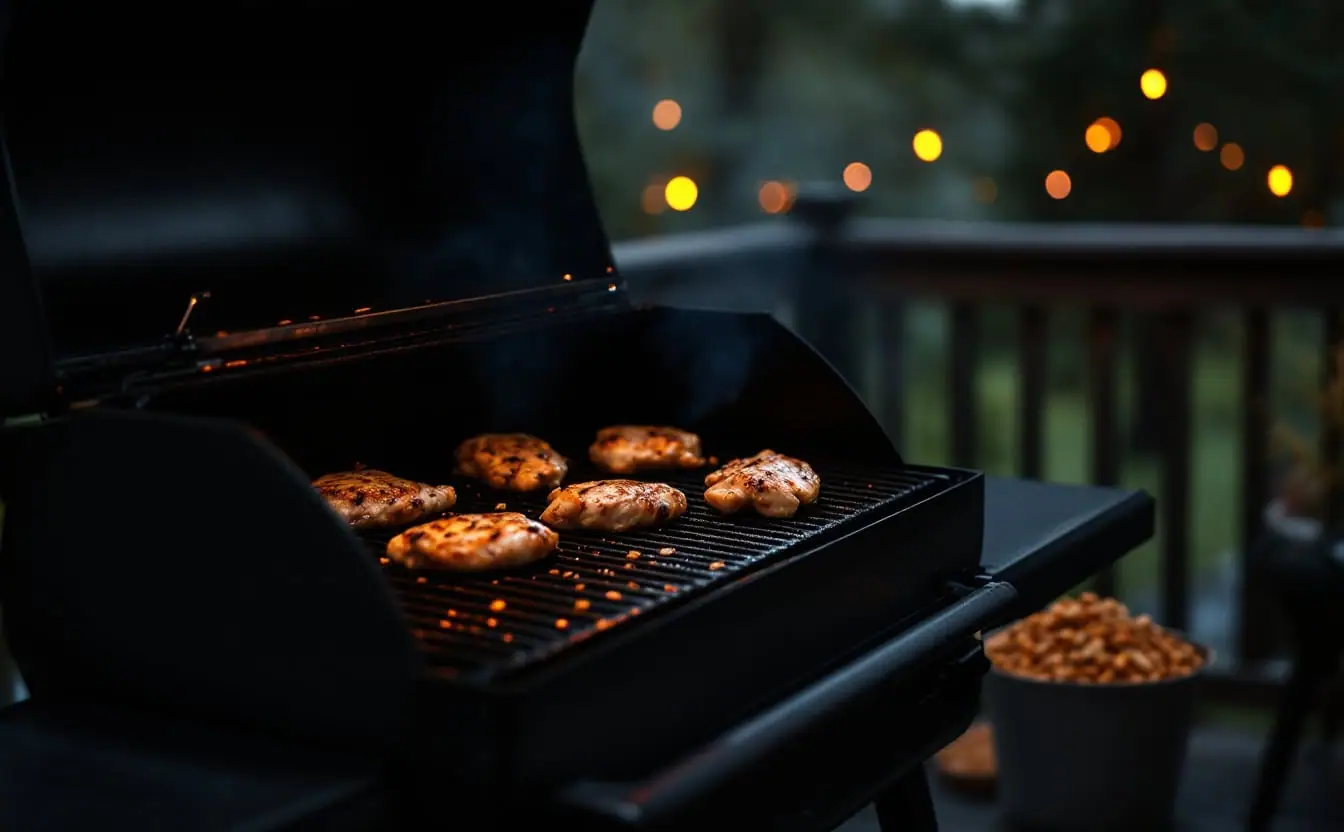
Bone-in, skin-on thighs, patted dry and seasoned, at 325 to 350°F (163 to 177°C) for 45 to 60 minutes. Chicken is safe at 165°F (74°C), but thighs are better at 175 to 185°F (79 to 85°C), once the connective tissue softens. They're nearly impossible to overcook, which makes them the ideal first cook.
Wings
Pat dry and toss with salt and about 1 teaspoon of baking powder per 450 g (1 lb). Smoke at 225°F (107°C) for 30 minutes, then raise the grill to 400 to 425°F (204 to 218°C) for another 30 to 40 minutes, turning once, until the skin is taut and golden. Chicken wings at home: fried, baked and smoked compares this with the other methods.
Sausages
Fresh sausages at 275 to 300°F (135 to 149°C) for 40 to 60 minutes. Gentle heat keeps the casings from splitting. Crank the grill for the last few minutes for colour.
Pork butt for pulled pork
This is what pellet grills were built for. Trim a bone-in pork shoulder of 3.5 to 4.5 kg (8 to 10 lb), leaving about 6 mm (1/4 in) of fat cap, and rub it the night before. Cook it fat side up at 225 to 250°F (107 to 121°C), budgeting roughly 1 1/2 to 2 hours per pound (450 g).
Somewhere around 150 to 170°F (66 to 77°C), the internal temperature will stall for hours as moisture evaporating from the surface cools the meat. Wait it out, or wrap the butt in butcher paper or foil to push through faster at the cost of a softer bark. Pull it at 195 to 205°F (91 to 96°C), when a probe slides in like it's going into soft butter. Rest it, still wrapped, in a dry cooler packed with towels for at least an hour. For game day: start the night before, hold it through pregame, shred at tip-off.
Where pellet grills fall short
Heat comes from one small fire under a baffle, spread by a fan. Most pellet grills top out somewhere around 450 to 500°F (232 to 260°C) at the grate, and that heat is mostly convection, not the radiant blast of a bed of coals. A steak will brown, but it won't get a dark, crusty sear. The workarounds:
- Reverse sear: cook steaks at 225°F (107°C) until 10 to 15°F (6 to 8°C) below your target, then sear in a very hot cast iron pan.
- Preheat a cast iron griddle on the grates at the highest setting and sear on that.
- Use the direct flame setting, if your grill has a slide plate over the firepot.
- Finish over coals. A pellet grill and a basic charcoal setup make a good team.
Target temperatures at a glance
| Food | Grill setting | Pull at (internal) | Rough time |
|---|---|---|---|
| Chicken thighs, bone-in | 325-350°F (163-177°C) | 175-185°F (79-85°C) | 45-60 min |
| Wings | 225°F (107°C), then 400-425°F (204-218°C) | 175-190°F (79-88°C) | 60-70 min |
| Fresh sausages | 275-300°F (135-149°C) | 160°F (71°C), poultry 165°F (74°C) | 40-60 min |
| Burgers, 2 cm (3/4 in) thick | 425-450°F (218-232°C) | 160°F (71°C) | 15-20 min |
| Pork butt | 225-250°F (107-121°C) | 195-205°F (91-96°C) | 1.5-2 h per lb (450 g) |
The safe minimums here, 165°F (74°C) for poultry and 160°F (71°C) for ground meat, match Health Canada and USDA guidance. Anything above them is about texture. For more ideas on what to put on the grates, see the grill section of the game-day food guide.
One note for Canadian winters: thin steel sheds heat, so a pellet grill burns noticeably more pellets in cold and wind. Park it out of the wind and keep the pellet bucket indoors.
For the very first cook, run the burn-in, then put on a full tray of thighs. By the time they reach 180°F (82°C), you'll know where your grill's hot spot is: under whichever thigh browned first.