Electric Smokers for Beginners: A Game-Day Guide
How an electric smoker works, how much smoke is enough, and a plan for wings, pulled pork sliders, sausages and smoked queso ready by tip-off.
By Megan Tremblay9 min read
My first pork shoulder came out of a borrowed electric smoker on a cold Saturday in October. I'd spent years cooking over gas and charcoal, and setting a dial, shutting a door and going about my day felt like cheating. That evening I pulled a shoulder with a dark, crackly bark and meat that fell apart under a fork.
Purists will tell you an electric smoker isn't real barbecue. They're welcome to tend a fire at 3 AM. If you want smoked food on the table for the game without learning fire management first, an electric unit is one of the easiest ways in.
How an electric smoker works
It's an insulated cabinet with racks, and almost every model shares the same parts:
- The heating element: a metal rod near the floor that cycles on and off to hold the temperature you set.
- The wood chip tray: a small metal box on or just above the element. The heat makes the chips smoulder rather than burn, and that's your smoke.
- The water pan: above the chips and below the food. It adds moisture, steadies the temperature and catches drips.
- The vents: a damper that keeps smoke moving instead of going stale.
- The controller: a digital panel or simple dial that tells the element when to switch on.
Because only a handful of chips is burning, the heat is steady and the smoke is clean and fairly mild.
Why it makes a good first smoker
Control, mostly. You set 225°F (107°C) and the smoker holds it without you managing fuel, airflow or a fire that dies at midnight. That frees your attention for the smoke and the bark.
They're tidy, too. No charcoal, no propane tank, no ash, just a plug, which makes them appealing for small yards and, in some buildings, balconies. If you'd rather learn on live fire, start with charcoal grilling for beginners. If you want hands-off cooking with a stronger wood character, pellet grills are the other route.
Before it goes on a balcony
Check your lease, your condo bylaws and your local fire rules first. Some buildings ban every grill and smoker on balconies, some allow electric units only, and some ban anything that makes smoke, because it drifts straight into your neighbours' windows. Where it's allowed, use a level, non-combustible surface clear of walls, railings and exits, and an outdoor-rated outlet with ground-fault protection. Follow the manual on extension cords. Never run a smoker indoors, in a garage or on an enclosed balcony; smouldering wood gives off carbon monoxide.
Seasoning a new unit
A new smoker has manufacturing residue on its walls that needs burning off. Follow your manual first, but most units go like this:
- Remove all packing material, then wash the racks, water pan and chip tray in warm soapy water and dry them.
- Wipe the interior walls with a light coat of neutral cooking oil.
- Run the empty smoker at its highest setting, often 275°F (135°C), for about 3 hours with the vent open, adding a load of chips for the last 45 minutes.
- Let it cool with the door closed.
The inside comes out lightly tanned. That's the start of the seasoning, so leave it. After each cook, wipe out grease and empty the drip tray, but don't scrub the walls back to bare metal.
Chips, chunks and how much smoke is enough
Electric smokers are built around wood chips, which smoulder quickly in a small tray. Chunks are usually too big for the tray and often won't catch from the element. Stick with chips unless your manual says otherwise, and don't soak them. Wet chips have to dry out before they smoulder, so all you get is steam and a delay.
Apple and cherry are mild and slightly sweet, good with poultry and pork. Hickory, oak and pecan are stronger and suit pork shoulder. Mesquite is intense, so blend it with something milder.
The most common beginner mistake is too much smoke. Meat takes on most of its smoke flavour in the first few hours, while the surface is cool and moist, and after that more smoke mostly adds bitterness. A sensible pattern is 1/2 to 1 cup of chips per load, a fresh load when the smoke thins (usually every 30 to 45 minutes), for the first 2 to 3 hours of a long cook. For wings and sausages, one or two loads is plenty.
Thin blue smoke, not white
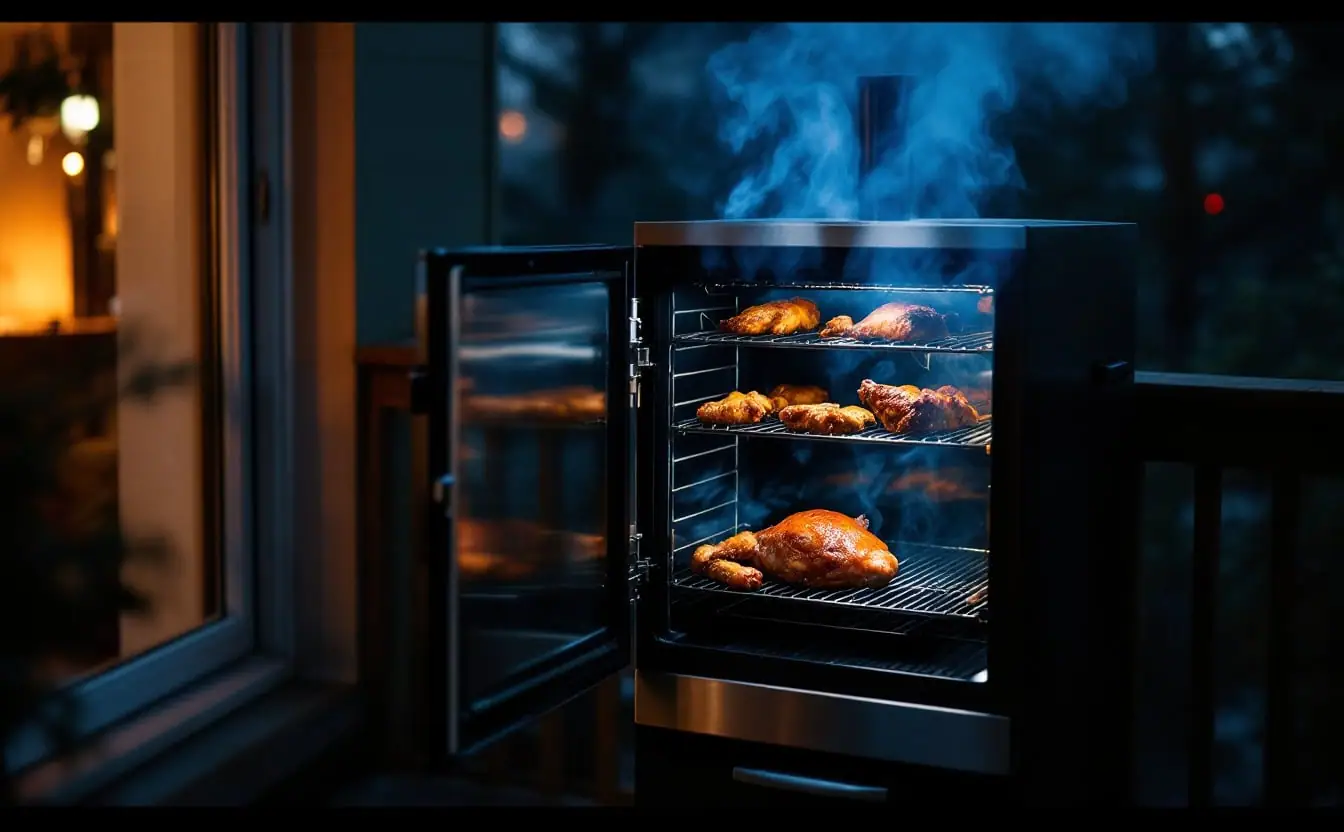
Watch the vent. You want thin, faintly blue smoke, more shimmer than cloud, with a sweet smell. That's wood smouldering cleanly.
Thick, white, billowing smoke means the wood is starved of air or still catching. A short burst right after you add chips is normal and settles in a few minutes. If it keeps pouring out white, open the top vent fully and use smaller loads, because long exposure to that smoke leaves food tasting acrid. Grey or black smoke means grease or something other than wood is burning, so check the drip tray.
One quirk: at low settings the element is often off and the chips can stop smoking. If that happens at 225°F (107°C), run at 250°F (121°C) for the first couple of hours.
What to cook for a game
Wings
Smoked wings taste great, but the skin goes rubbery straight from a low smoker. Run the smoker at its top setting, ideally 275°F (135°C), with apple or cherry chips, and smoke the wings for 60 to 75 minutes to 165°F (74°C). Then crisp them in a 450°F (232°C) oven for 10 to 15 minutes and sauce them right before serving. There's more in my comparison of fried, baked and smoked wings.
Pork shoulder for pulled pork sliders
This is the cook electric smokers were made for. Buy a bone-in pork butt (the upper shoulder) of 6 to 7 pounds (2.7 to 3.2 kg). The night before, rub it with salt, black pepper, paprika, brown sugar and garlic powder, and refrigerate it uncovered.
Smoke at 250°F (121°C) with hickory. Plan on roughly 1 1/2 to 2 hours per pound (450 g), but cook to tenderness, not the clock. It's ready at 195 to 205°F (91 to 96°C), when a probe slides in like it's going into soft butter and the bone wiggles loose. Wrap it in foil, then old towels, and rest it in a dry cooler for at least an hour. Pull it, discard the fat seams, and toss it with the foil juices and some cider vinegar sauce. That's enough for about 20 to 25 sliders with coleslaw and pickles.
Sausages
At 250 to 275°F (121 to 135°C), fresh sausages need about 1 to 1 1/2 hours to reach 160°F (71°C) for pork or 165°F (74°C) for chicken. A minute or two in a hot pan at the end brings back the snap of the casing.
Smoked queso dip
In a 9 by 13 inch (23 by 33 cm) foil pan, combine:
- 2 pounds (900 g) processed cheese, cubed
- 8 ounces (225 g) shredded pepper Jack
- 1 pound (450 g) fresh chorizo or ground beef, browned and drained
- One 10 ounce (284 ml) can of diced tomatoes with green chiles
- 1 small onion and 2 jalapeños, diced
- 1/2 cup (125 ml) milk
Smoke at 250 to 275°F (121 to 135°C) for 60 to 90 minutes, stirring every 20 minutes so it melts evenly. Serve with sturdy tortilla chips.
A game-day timeline
Here's how it fits on one mid-sized electric smoker for a 7:00 PM tip-off. The pork comes off before everything else goes in, so the smoker can be turned up for the wings.
| Time | Step |
|---|---|
| Night before | Rub the shoulder. Salt the wings and rack them uncovered in the fridge |
| 5:30 AM | Smoker on at 250°F (121°C), water pan filled with hot water |
| 6:00 AM | Shoulder on. Fresh chips about every 45 minutes until 9:00 AM |
| 11:00 AM to 1:00 PM | The stall usually arrives. Wrap once the bark is set |
| 3:30 to 5:00 PM | Shoulder probe tender at 195 to 205°F (91 to 96°C). Into the cooler; smoker up to 275°F (135°C), fresh chips |
| 5:00 PM | Sausages and queso on, wings 15 minutes later |
| 6:15 PM | Sausages into a covered foil pan with onions and a splash of beer, back on the bottom rack |
| 6:30 PM | Wings out and into a 450°F (232°C) oven. Pull the pork |
| 6:45 PM | Sauce the wings. Sliders, queso and sausages out |
| 7:00 PM | Tip-off |
If the pork is done at 3:30 PM, it waits in the cooler, which keeps it above 140°F (60°C) for a few hours if it's well packed. If it isn't tender by 5:00 PM, move it, still wrapped, into a 275°F (135°C) oven. The smoke flavour is already in it, and the smoker is free for everything else. The watch party planning checklist covers drinks, seating and how much food per person.
The stall
Somewhere around 150 to 170°F (66 to 77°C), a big cut like pork shoulder stops climbing and can sit flat for hours. Nearly every first-timer assumes the smoker has broken. It hasn't. Moisture evaporating from the surface is cooling the meat, the same way sweat cools you, and for a while that roughly cancels out the heat going in.
You can wait it out, which gives you the firmest bark. Or wrap the shoulder tightly in foil or unwaxed butcher paper once the bark is deep mahogany and doesn't rub off on your finger. Wrapping stops the evaporation and pushes the meat through much faster. Foil is quickest but softens the bark; paper lands in between. What you shouldn't do is crank the temperature or keep opening the door.
Smoking in cold weather
An electric smoker is a metal box with a modest element, and in a Canadian winter it can lose heat faster than it makes it. In cold or wind it may never reach its top setting, and it recovers slowly every time the door opens.
- Preheat 20 to 30 minutes longer than usual.
- Get it out of the wind. A windbreak on the exposed side makes more difference than you'd expect.
- Use an insulated cover made and rated for smokers, never a moving blanket or tarp.
- Keep the door shut and add time to the plan.
- Keep the controller, plug and cord dry and clear of snow.
If your shoulder is still at 160°F (71°C) at 4:00 PM on a January afternoon, the oven finish from the timeline is there for exactly that.
What to look for if you're buying one
No brand picks here, since models change every year. Check these features instead:
- A temperature range that reaches at least 275°F (135°C). Poultry skin needs that top end.
- A chip loader that works without opening the door. Every time the main door opens you lose heat and smoke.
- Double-walled insulation for cold weather.
- A built-in meat probe, or a port for one, so you can read the meat without opening the door.
- A tight door seal and latch.
- Racks big enough for a whole pork shoulder or a full rack of ribs.
- A removable, easy-to-clean drip tray.
Check the built-in thermometer against a separate probe on your first cook. Then start with a pork shoulder on a quiet Saturday, write down when it went on, when it stalled and when it came off, and by playoff season you'll know exactly what time to set the alarm.